Read ·
Who Is the Rock in Matthew 16:18?
“Upon this rock I will build my church” is one of the most debated sentences in the Gospels. The earliest Christian writers did not read it in a single way, and their disagreements are older than any modern church division.
by VRSZ Editors · November 18, 2026 · 5 min read
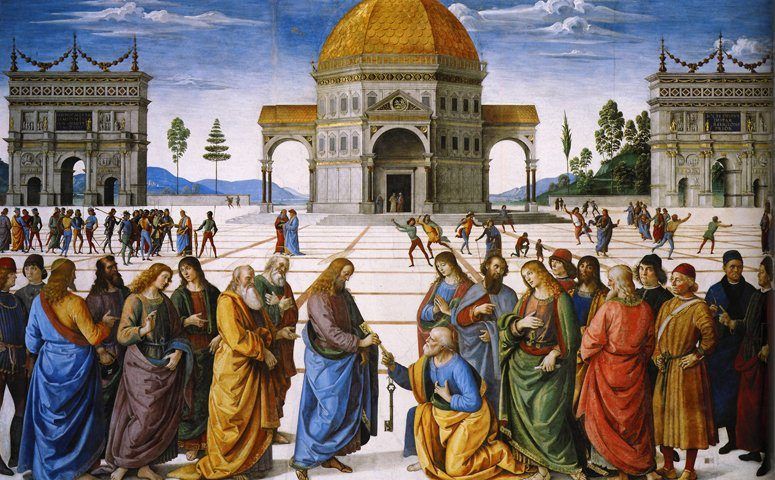
The scene takes place near Caesarea Philippi, far to the north of Galilee. Jesus asks his disciples who people say he is, and then who they say he is. Simon answers for the group, and Jesus answers him with a new name and a promise. Few verses have been argued over more. The question at the center of the upon this rock meaning is simple to state: what is the rock? Is it Peter himself, the faith Peter has just confessed, or Christ? The early Church gave more than one answer, and it is worth hearing them side by side.
The passage: Matthew 16:15–19
“He saith unto them, But whom say ye that I am? And Simon Peter answered and said, Thou art the Christ, the Son of the living God... And I say also unto thee, That thou art Peter, and upon this rock I will build my church; and the gates of hell shall not prevail against it. And I will give unto thee the keys of the kingdom of heaven...”
The wordplay matters. In Greek, Peter’s new name is Petros, and “rock” is petra.
Origen: every confessor becomes a rock
Origen of Alexandria, writing his commentary on Matthew in the third century, read the promise as something that spreads outward from Peter. Anyone who makes the same confession by the same light from the Father, he argued, stands where Peter stood. If we too say “You are the Christ, the Son of the living God,” then “we become a Peter.”
He pushed the point further: “For a rock is every disciple of Christ.” Origen did not deny that the words were spoken to Peter. He simply refused to let them stop there, asking what the same promise would mean for John “or each one of the Apostles.”
Cyprian: one beginning for one Church
Cyprian, bishop of Carthage in the 250s, wrote during a schism, and he read the verse as a lesson in unity. He quoted Matthew 16 together with John 21, where Jesus tells Peter to feed his sheep, and with John 20, where the risen Christ gives the same authority to all the apostles.
Cyprian held both points at once. “Assuredly the rest of the apostles were also the same as was Peter, endowed with a like partnership both of honour and power.” Yet Christ spoke first to one man, so that the Church would have a single starting point: “the beginning proceeds from unity.”
John Chrysostom: the faith of his confession
Preaching in Antioch in the 390s, John Chrysostom gave a compact gloss. “Upon this rock will I build my Church” means, he said, “on the faith of his confession.” In the same breath he stresses what the promise does for Peter personally: Jesus “raises his spirit, and makes him a shepherd.”
For Chrysostom the honor is real, but it is tied to the words Peter has just spoken. The rock is the confession that Jesus is the Christ, the Son of the living God.
Upon this rock meaning: Augustine’s answer
Augustine of Hippo, preaching on the last chapter of John’s Gospel, drew the sharpest line of all. In his reading Peter stands for the whole Church, which is shaken by storms “and falls not, because it is founded upon a rock (petra), from which Peter received his name.”
Then comes the line that gives this article its headline: “For petra (rock) is not derived from Peter, but Peter from petra; just as Christ is not called so from the Christian, but the Christian from Christ.” The rock, for Augustine, is the one Peter confessed. He cites Paul directly: “For the Rock (Petra) was Christ.” Peter, he adds, was himself built on that foundation.
Augustine does not belittle Peter. In the same passage he calls him “the first apostle” and says the keys were given to the Church “in the person of Peter.”
One verse, several foundations
Taken together, these four writers show a range rather than a single party line. Cyprian focuses on Peter as the visible starting point of unity, Chrysostom on Peter’s confession, Origen on every believer who repeats it, and Augustine on Christ, the rock from which Peter’s name was taken. Christian traditions today still lean on different parts of this range. The early sources at least make one thing clear. None of them could talk about the rock without also talking about the confession: “Thou art the Christ, the Son of the living God.”
Read it for yourself
Each verse of Matthew 16:13–19 has its own commentaries on VRSZ. Read the question at Caesarea Philippi, Peter’s answer and the promise of the keys one line at a time, with the early Church’s comments beside each one. Tap Matthew 16:18 on VRSZ to start.
Matthew xvi. 18
18And I say also unto thee, That thou art Peter, and upon this rock I will build my church; and the gates of hell shall not prevail against it.
Read the commentaries on Matthew 16:18Know someone who would want to read this?
Sources quoted
- Origen, Commentary on Matthew XII.10–11, trans. John Patrick (ANF vol. 9), newadvent.org/fathers/101612.htm.
- Cyprian of Carthage, On the Unity of the Church 4, trans. Robert Ernest Wallis (ANF vol. 5), newadvent.org/fathers/050701.htm.
- John Chrysostom, Homilies on Matthew 54.3, trans. George Prevost, rev. M. B. Riddle (NPNF, 1st series, vol. 10), newadvent.org/fathers/200154.htm.
- Augustine of Hippo, Tractates on the Gospel of John 124.5, trans. John Gibb (NPNF, 1st series, vol. 7), newadvent.org/fathers/1701124.htm.
- Matthew 16:13–19, King James Version.