Read ·
What Does the Raising of Lazarus Mean?
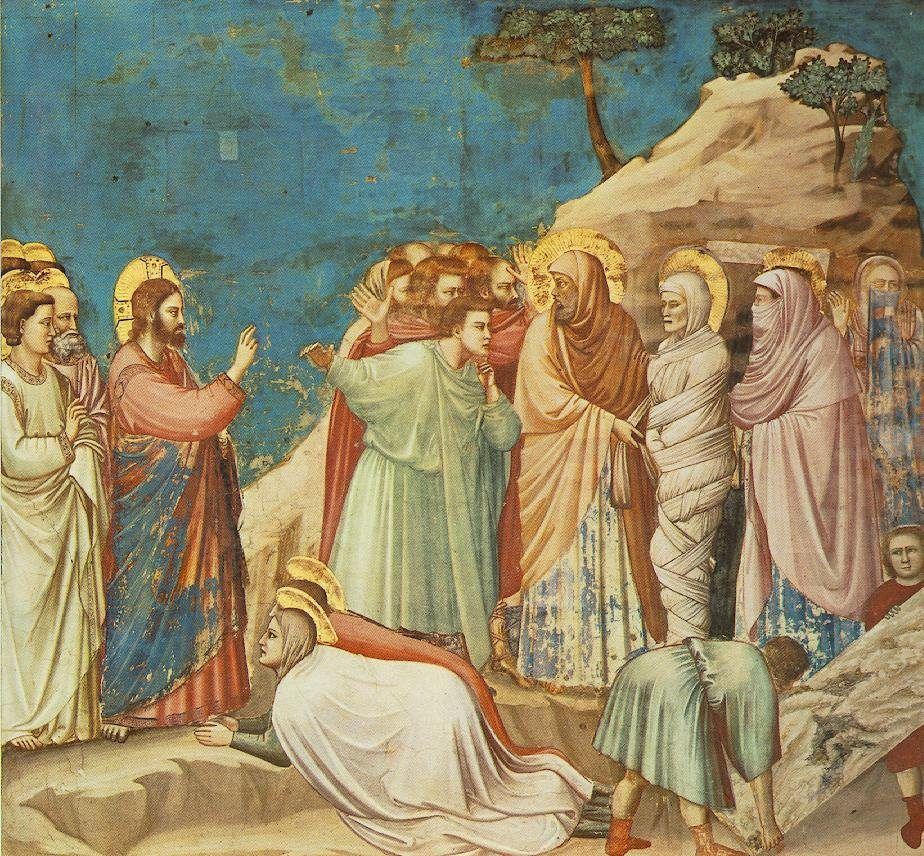
The raising of Lazarus is the last and greatest of the signs in John’s Gospel. A man four days dead walks out of his tomb. Yet the early Church’s commentators kept turning attention to quieter details: Jesus’ tears, the stone, and the grave-clothes still wrapped around the living man.
by VRSZ Editors · November 14, 2026 · 5 min read
John 11 contains the shortest verse in the English Bible, “Jesus wept,” and one of its most dramatic scenes. Jesus arrives at Bethany after his friend Lazarus has been in the tomb four days, orders the stone rolled away, and calls him out by name. The meaning of the raising of Lazarus was never only about a single resurrection to the early Church. Preachers in Antioch and Hippo asked why the story is told the way it is, and what it says about the one who wept and the one who walked out.
The passage: John 11:38–44
“Jesus therefore again groaning in himself cometh to the grave. It was a cave, and a stone lay upon it. Jesus said, Take ye away the stone. Martha, the sister of him that was dead, saith unto him, Lord, by this time he stinketh: for he hath been dead four days... And when he thus had spoken, he cried with a loud voice, Lazarus, come forth. And he that was dead came forth, bound hand and foot with graveclothes: and his face was bound about with a napkin. Jesus saith unto them, Loose him, and let him go.”
Augustine: the bigger miracle happens every day
Augustine opened his sermon on this chapter with an unexpected comparison. Everyone marvels at a dead man coming back to life. But Jesus is the one through whom all things were made, and new people are born every day by that same power. Seen that way, Augustine says, “It is a greater deed to create men than to raise them again from the dead.”
He did not mean to shrink the miracle. He meant to show who was standing at the tomb. The one who called Lazarus out was the one who had made him in the first place.
Three raisings, three kinds of death
Augustine then compared the three people the Gospels record Jesus raising: the daughter of the synagogue ruler, still lying in the house; the widow’s son at Nain, already being carried out of the city; and Lazarus, four days in the grave. He read them as pictures of the soul. Sin may be hidden in thought, it may come out into action, or it may become a settled way of life.
Lazarus stands for the last and hardest case. “The third example of death is Lazarus,” Augustine says, and it is “distinguished as a habit of wickedness.” That is why the scene is so heavy with effort. “He groaned, He wept, He cried with a loud voice. With what difficulty does one rise who lies crushed under the heavy burden of a habit of sinning!” And yet, he adds, the man rises.
Augustine also noticed that Lazarus came out still bound. Coming out of the tomb was “the power of the Lord,” not “the strength of the dead.” Then Jesus tells others to finish the work: “Loose him, and let him go.” Augustine connected this unbinding with the forgiveness Christ entrusted to his followers.
The raising of Lazarus meaning: why “Jesus wept”
John Chrysostom, preaching through John’s Gospel in Antioch, asked why the evangelist goes out of his way to mention that Jesus wept and groaned. John is the Gospel that speaks most loftily about Christ, calling him the Word who was with God. So why linger on his tears? Chrysostom’s answer: “That you may learn that He had of a truth put on our nature.”
In other words, the tears are not a weakness in the story. They are part of its message. The one who raises the dead is truly human, grieving at a friend’s grave.
Why the stone and the grave-clothes?
Chrysostom also asked a practical question. If Jesus could call a dead man to life with a word, he could surely move a stone with one. Why tell the bystanders to roll it away? “In order to make them witnesses of the miracle,” he says. Their own hands, the smell Martha warned of, and the grave-clothes they recognized all served as evidence that left no room to claim it was someone else.
A story about two kinds of life
Read with these early commentators, John 11 holds two truths together. Jesus is fully human, enough to weep at a grave. He is also the Creator, for whom bringing a man back is less remarkable than making him at all. And the story does not end with Lazarus standing in the doorway of the tomb. It ends with a command to the people around him: unbind him and let him go.
Read it for yourself
Each verse of John 11 has its own commentaries on VRSZ. Follow the story from the message to Bethany to the empty tomb with Augustine, Chrysostom and other early writers. Tap John 11:43 on VRSZ to start.
John xi. 43
43And when he thus had spoken, he cried with a loud voice, Lazarus, come forth.
Read the commentaries on John 11:43Know someone who would want to read this?
Sources quoted
- Augustine of Hippo, Tractates on the Gospel of John 49, trans. John Gibb (NPNF, 1st series, vol. 7), newadvent.org/fathers/1701049.htm.
- John Chrysostom, Homilies on the Gospel of John 63, trans. Charles Marriott (NPNF, 1st series, vol. 14), newadvent.org/fathers/240163.htm.
- John 11, King James Version.