Read ·
What Does the Sacrifice of Isaac in Genesis 22 Mean?
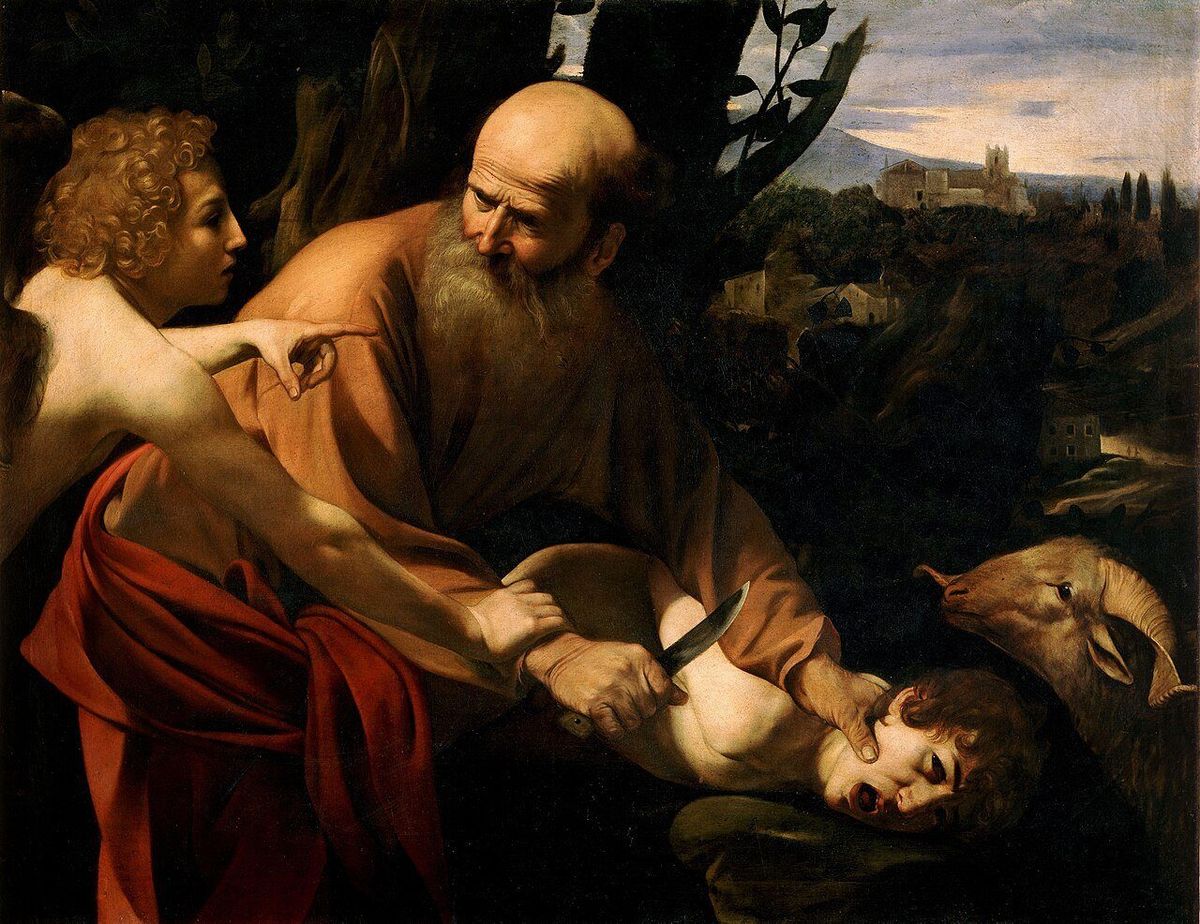
Genesis 22, where God tells Abraham to offer his son Isaac, is one of the hardest stories in Scripture. Early Christian writers did not explain it away. They noticed details such as the wood on Isaac’s back and the ram tangled by its horns, and they saw another father and another son in them.
by VRSZ Editors · November 16, 2026 · 5 min read
Few passages trouble modern readers more than the binding of Isaac. God tells Abraham to take “thine only son Isaac, whom thou lovest” up a mountain and offer him as a burnt offering. Abraham goes. At the last moment an angel stops his hand, and a ram caught in a thicket is offered instead. For the earliest Christian commentators, the meaning of the sacrifice of Isaac lay partly in what it said about Abraham’s faith and partly in what it pointed toward.
The passage: Genesis 22:1–14
“And he said, Take now thy son, thine only son Isaac, whom thou lovest, and get thee into the land of Moriah; and offer him there for a burnt offering upon one of the mountains which I will tell thee of... And Abraham took the wood of the burnt offering, and laid it upon Isaac his son... And Isaac spake unto Abraham his father, and said, My father: and he said, Here am I, my son. And he said, Behold the fire and the wood: but where is the lamb for a burnt offering? And Abraham said, My son, God will provide himself a lamb for a burnt offering... And Abraham lifted up his eyes, and looked, and behold behind him a ram caught in a thicket by his horns.”
Augustine: Abraham expected a resurrection
Augustine discussed the story in The City of God, and he began with the moral problem. Did Abraham think God wanted human sacrifice? No: “Of course Abraham could never believe that God delighted in human sacrifices; yet when the divine commandment thundered, it was to be obeyed, not disputed.”
What made Abraham’s obedience faith rather than mere submission, Augustine argued, was what he expected to happen. God had already promised that Abraham’s line would come through Isaac. So Abraham “all along believed that his son, on being offered up, would rise again.” Augustine was following the Letter to the Hebrews, which says Abraham reasoned “that God was able to raise him up, even from the dead.”
Augustine also handled the line “now I know that thou fearest God.” Did God need a test to find out? His answer: “Now I know, that is, Now I have made to be known; for God was not previously ignorant of this.” The test revealed Abraham’s faith to Abraham and to everyone who would read about it.
The sacrifice of Isaac meaning: the wood and the ram
Then Augustine turned to the details. Isaac climbed Moriah with the wood for his own sacrifice on his back. “Isaac also himself carried to the place of sacrifice the wood on which he was to be offered up, just as the Lord Himself carried His own cross.”
And the ram? Isaac was spared, but a sacrifice was still made. Augustine asked whom the ram, caught by its horns in a thicket, could represent. His answer was Jesus, crowned with thorns before he was offered up.
Tertullian and Irenaeus: the same picture, earlier
Augustine was not the first to see this. Writing in North Africa around two centuries earlier, Tertullian made the same connections. “Isaac, when led by his father as a victim, and himself bearing his own wood, was even at that early period pointing to Christ’s death.” Later in the same work he set the ram “caught by the horns in the bramble” beside Christ carrying his own wood, “with a thorny crown encircling His head.”
Irenaeus of Lyon, writing in the late second century, drew out the parallel between the two fathers. Abraham, he wrote, “with a ready mind delivered up, as a sacrifice to God, his only-begotten and beloved son, in order that God also might be pleased to offer up for all his seed His own beloved and only-begotten Son, as a sacrifice for our redemption.”
Irenaeus also made it personal. Christians who share Abraham’s faith follow Christ, he said, “taking up the cross as Isaac did the wood.”
A story that does not end in death
These early readers did not make Genesis 22 comfortable. They took its demand seriously and admitted that Abraham’s obedience was costly. But they also read it in light of how it ends: the knife stopped, the son given back, and a substitute provided on the mountain. Abraham named the place Jehovah-jireh, which means the LORD will provide.
For Augustine, Tertullian and Irenaeus, the story’s deepest meaning lay in the details. A son carries wood up a hill. A father does not withhold him. A ram with its head caught in thorns takes his place.
Read it for yourself
Each verse of Genesis 22 has its own commentaries on VRSZ. Follow Abraham and Isaac up Moriah with Augustine, Irenaeus and other early writers. Tap Genesis 22:8 on VRSZ to start.
Genesis xxii. 8
8And Abraham said, My son, God will provide himself a lamb for a burnt offering: so they went both of them together.
Read the commentaries on Genesis 22:8Know someone who would want to read this?
Sources quoted
- Augustine of Hippo, The City of God XVI.32, trans. Marcus Dods (NPNF, 1st series, vol. 2), newadvent.org/fathers/120116.htm.
- Tertullian, An Answer to the Jews 10 and 13, trans. S. Thelwall (ANF vol. 3), newadvent.org/fathers/0308.htm.
- Irenaeus of Lyon, Against Heresies IV.5.4, trans. Roberts and Rambaut (ANF vol. 1), newadvent.org/fathers/0103405.htm.
- Genesis 22:1–14; Hebrews 11:17–19, King James Version.