Read ·
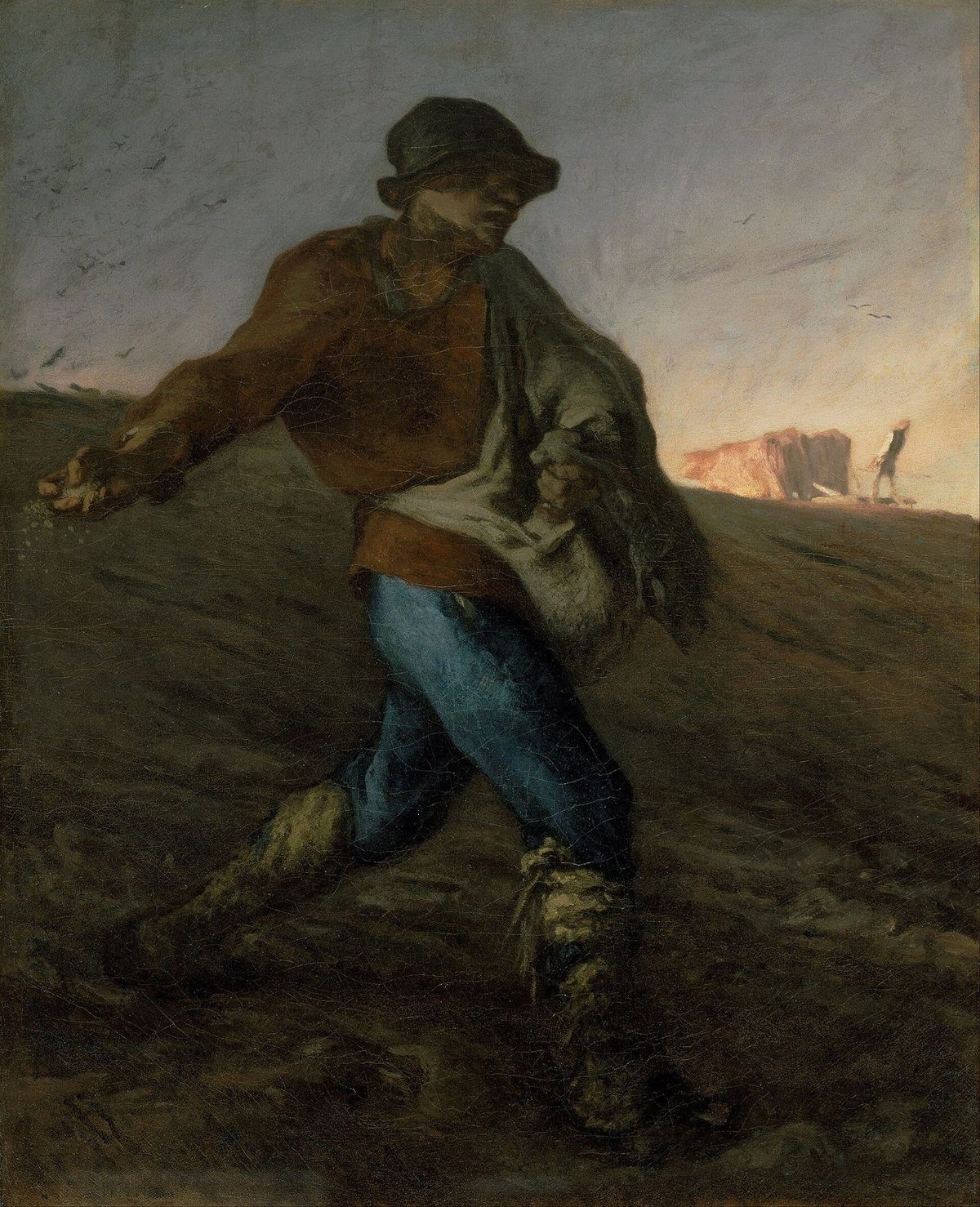
What Does the Parable of the Sower Mean?
In the parable of the sower, three parts of the seed are lost and only one bears fruit. Two early preachers asked why a sensible farmer would waste seed on rock and thorns, and both found hope in their answer.
by VRSZ Editors · November 20, 2026 · 5 min read
The parable of the sower is one of the few parables Jesus explains himself, and that makes it easy to read too fast. Seed falls on a path, on rocky ground, among thorns and on good soil. The birds take the first, the sun burns the second, the thorns choke the third, and only the last produces a harvest. The explanation that follows matches each kind of ground to a kind of listener. For early Christian preachers, the parable of the sower meaning raised a further question that the explanation leaves open. Why does the sower throw seed where it cannot grow? And is the ground fixed forever?
The passage: Matthew 13:3–9, 18–23
“Behold, a sower went forth to sow; And when he sowed, some seeds fell by the way side, and the fowls came and devoured them up: Some fell upon stony places, where they had not much earth... And some fell among thorns; and the thorns sprung up, and choked them: But other fell into good ground, and brought forth fruit, some an hundredfold, some sixtyfold, some thirtyfold.”
In the explanation, the thorns are “the care of this world, and the deceitfulness of riches,” which “choke the word.”
John Chrysostom: the sower who went out
John Chrysostom preached through Matthew in Antioch in the 390s. He paused first on the opening words, “a sower went forth.” How can someone who is present everywhere go out anywhere? “Not in place,” Chrysostom answered, “but in condition and dispensation to usward, coming nearer to us by His clothing Himself with flesh.” The sower is Christ, the seed is his teaching, and the ground is “the souls of men.”
He did the arithmetic plainly: “Three parts perish, and one is saved.” But he refused to blame the sower for the loss. The seed was lost “Not through the sower, but through the ground that received it.”
A rocky heart is not a rock
Then Chrysostom raised the objection a farmer would raise. Is it reasonable “to sow among the thorns, on the rock, on the wayside?” With real fields, no. A farmer who did it would be blamed, because rock cannot turn into soil.
People, he argued, are different. “There is such a thing as the rock changing, and becoming rich land; and the wayside being no longer trampled on, nor lying open to all that pass by, but that it may be a fertile field.” That, for Chrysostom, is why the sower keeps sowing everywhere. “For had it been impossible, this Sower would not have sown.”
He also noticed what Jesus left unsaid. Jesus does not name and shame the careless, the rich or the shallow. “It is not His will to rebuke them severely, lest He should cast them into despair.”
Parable of the sower meaning: Augustine’s “be changed”
Across the Mediterranean, Augustine of Hippo preached the same parable to his congregation in North Africa. His congregation had heard the sower read one day and the wheat and tares the next, and in the second sermon he looked back at what he had said the day before. He had “addressed the way side, I addressed the stony ground, I addressed the thorny places; and I said, Be changed while ye may.”
His instructions read like a farmer’s work list: “turn up with the plough the hard ground, cast the stones out of the field, pluck up the thorns out of it.” And he made the call personal. “Be loth to retain that hard heart, from which the word of God may quickly pass away and be lost.”
Augustine also made room for different yields. “In one the fruit is more, in another less; but all will have a place in the barn.”
The ground can move
Read together, the two preachers make the same surprising move. The parable sorts listeners into four kinds of ground, but neither Chrysostom nor Augustine treated the sorting as final. The hard path can be broken up, the stones can be cleared, the thorns can be pulled. The sower’s apparent waste becomes a sign of hope: he scatters seed everywhere because no ground is beyond change.
Read it for yourself
Each verse of Matthew 13:1–23 has its own commentaries on VRSZ. Follow the seed from the wayside to the good ground, and read what the early Church said about each kind of soil. Tap Matthew 13:3 on VRSZ to start.
Matthew xiii. 3
3And he spake many things unto them in parables, saying, Behold, a sower went forth to sow;
Read the commentaries on Matthew 13:3Know someone who would want to read this?
Sources quoted
- John Chrysostom, Homilies on Matthew 44.3–5, trans. George Prevost, rev. M. B. Riddle (NPNF, 1st series, vol. 10), newadvent.org/fathers/200144.htm.
- Augustine of Hippo, Sermons on the New Testament 23 (Ben. 73).3, trans. R. G. MacMullen (NPNF, 1st series, vol. 6), newadvent.org/fathers/160323.htm.
- Matthew 13:1–23, King James Version.