Read ·
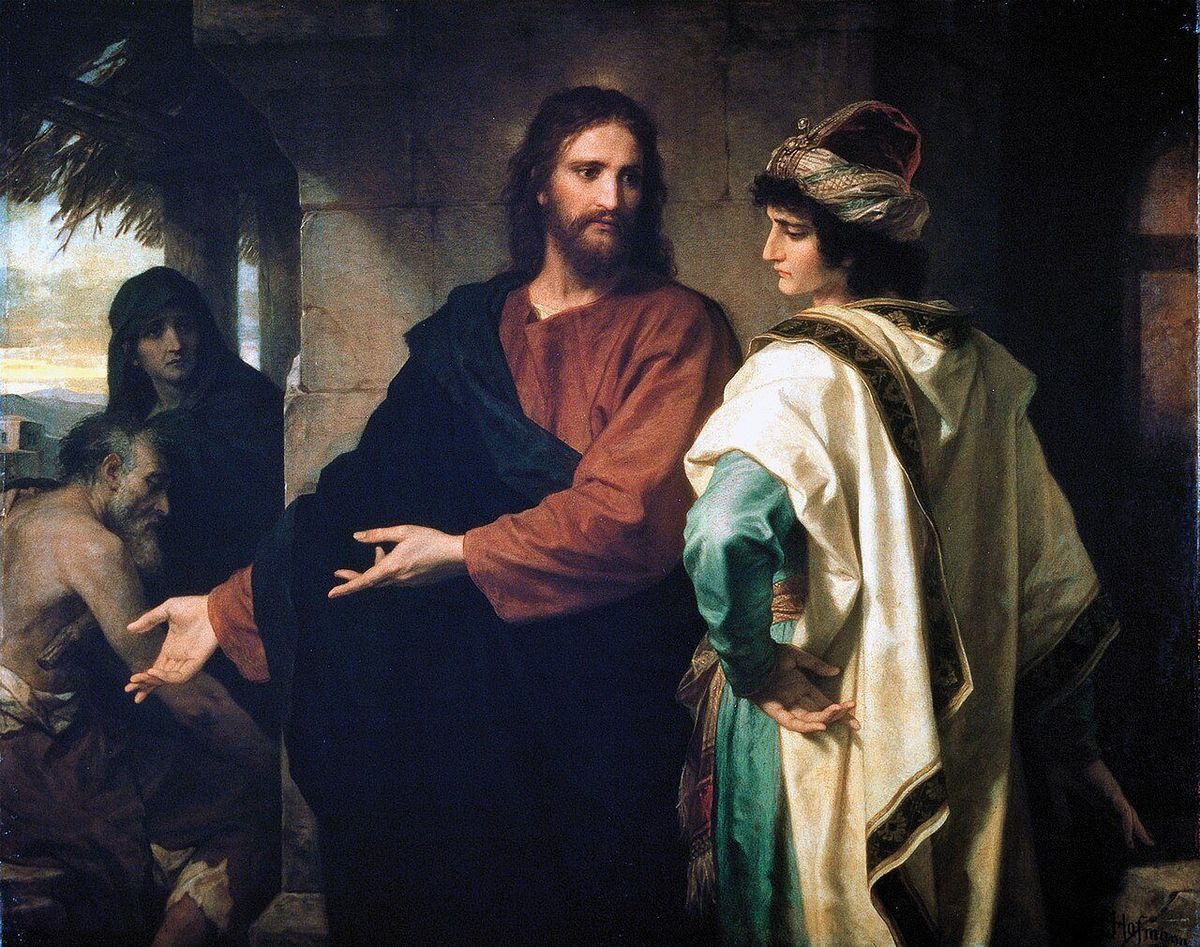
Who Was the Rich Young Man in Matthew 19?
A wealthy young man asks Jesus how to gain eternal life, hears “sell that thou hast,” and walks away sad. Ever since, Christians have argued over what the story asks of people with money. Two of the earliest answers came from Alexandria and Antioch.
by VRSZ Editors · November 10, 2026 · 5 min read
The story of the rich young man appears in Matthew, Mark and Luke, which tells you how much the first Christians wanted it remembered. It also contains one of Jesus’ most startling images: a camel squeezing through the eye of a needle. What is the meaning of the rich young man story? Does it command every follower to give everything away, or was it aimed at one man’s particular attachment? The early Church did not give a single answer, but two writers show how seriously they took the question.
The passage: Matthew 19:16–26
“And, behold, one came and said unto him, Good Master, what good thing shall I do, that I may have eternal life?” Jesus points him to the commandments. The young man says he has kept them all and asks, “what lack I yet?”
“Jesus said unto him, If thou wilt be perfect, go and sell that thou hast, and give to the poor, and thou shalt have treasure in heaven: and come and follow me. But when the young man heard that saying, he went away sorrowful: for he had great possessions.” Jesus then tells his disciples, “It is easier for a camel to go through the eye of a needle, than for a rich man to enter into the kingdom of God.” Astonished, they ask who can be saved. “With men this is impossible; but with God all things are possible.”
Clement of Alexandria: the money is not the enemy
Around AD 200, Clement of Alexandria wrote a short treatise with a pointed title: Who Is the Rich Man That Shall Be Saved? He wrote it for wealthy Christians who had read this story and despaired.
Clement argued that the command “sell your possessions” reaches deeper than the purse. “He does not, as some conceive off-hand, bid him throw away the substance he possessed, and abandon his property.” Instead, Jesus “bids him banish from his soul his notions about wealth, his excitement and morbid feeling about it, the anxieties, which are the thorns of existence, which choke the seed of life.”
He then compares wealth to a tool. A tool in skilled hands does good work, and in clumsy hands does damage, but the tool itself is not to blame. “Such an instrument is wealth.” Used well, it serves justice. Used badly, it serves wrong. Its proper place is fixed: “its nature is to be subservient, not to rule.”
Clement was not offering a loophole. The rest of his treatise urges the rich to give generously and to treat their wealth as something held for others. His point was that a person could give everything away and still be ruled by the love of money, and that the real surgery happens inside.
Rich young man meaning: Chrysostom on the thorns
Two centuries later, John Chrysostom preached on the same passage in Antioch, and he was less inclined to soften it. He admired the young man’s eagerness. Unlike many who approached Jesus to test him or ask for healing, this man asked about eternal life. “For fertile was the land and rich, but the multitude of the thorns choked the seed.”
That echo of the parable of the sower is shared by both writers: wealth works like thorns. Chrysostom added an observation about how the thorns grow. Having more does not quench the desire for more. “The increase of acquisitions kindles the flame more, and renders the getters poorer,” because the wealthy feel their wants all the more sharply.
The camel and the needle
Was Jesus exaggerating? Some modern readers explain the camel saying by appeal to a small gate in Jerusalem called “the needle’s eye.” Chrysostom did not reach for any such device. He took the saying at full strength, saying Jesus showed it was not merely hard but “even in the highest degree impossible.”
The point, in Chrysostom’s reading, is the line that follows. Salvation for the rich is “a work of God,” and so “great grace is needed” for anyone who is going to achieve it.
One story, two emphases
Clement and Chrysostom can sound like they disagree, one protecting the wealthy from despair and the other warning them against comfort. But they share the same diagnosis. The problem is not coins in a purse. It is what possessions do to a soul: crowd it, choke it, and leave it hungry for more.
Where they leave the reader is the same place the disciples were left: astonished, asking who then can be saved, and hearing that what is impossible for people is possible with God.
Read it for yourself
Each verse of Matthew 19:16–26 has its own commentaries on VRSZ. Follow the conversation between Jesus and the rich young man with Clement, Chrysostom and other early writers. Tap Matthew 19:21 on VRSZ to start.
Matthew xix. 21
21Jesus said unto him, If thou wilt be perfect, go and sell that thou hast, and give to the poor, and thou shalt have treasure in heaven: and come and follow me.
Read the commentaries on Matthew 19:21Know someone who would want to read this?
Sources quoted
- Clement of Alexandria, Who Is the Rich Man That Shall Be Saved? 11 and 14, trans. William Wilson (ANF vol. 2), newadvent.org/fathers/0207.htm.
- John Chrysostom, Homilies on Matthew 63, trans. George Prevost, rev. M. B. Riddle (NPNF, 1st series, vol. 10), newadvent.org/fathers/200163.htm.
- Matthew 19:16–26, King James Version.