Read ·
What the Early Church Fathers Said About Psalm 23
Psalm 23 is read at funerals more than almost any other text, and its “valley of the shadow of death” is usually heard as the hour of dying. Early Christian writers heard something else. For them the psalm described the whole Christian life, from baptism to the table.
by VRSZ Editors · October 31, 2026 · 5 min read
Psalm 23 may be the best-known poem in the Bible. “The LORD is my shepherd” turns up on sympathy cards, in hospital chapels and at gravesides. But the meaning of Psalm 23 for the first Christian interpreters was not mainly about death. Bishops in Jerusalem, Milan and Hippo read it as a map of what happens to a believer: led to water, anointed, seated at a table, followed by mercy. Augustine went further and said the dark valley is not the end of life at all. It is the life we are living now.
The passage: Psalm 23
“The LORD is my shepherd; I shall not want. He maketh me to lie down in green pastures: he leadeth me beside the still waters. He restoreth my soul... Yea, though I walk through the valley of the shadow of death, I will fear no evil: for thou art with me; thy rod and thy staff they comfort me. Thou preparest a table before me in the presence of mine enemies: thou anointest my head with oil; my cup runneth over.”
A note on numbering: Greek and Latin Bibles count this psalm as Psalm 22, so older translations of the Fathers often cite it that way.
Augustine: the shepherd, the water and the shadow
Augustine’s short exposition reads the psalm as the voice of the Church speaking to Christ. The first line becomes a confession: “The Lord Jesus Christ is my Shepherd, and I shall lack nothing.” The still waters are not just a pleasant stream. “By the water of baptism,” he writes, the Shepherd has brought the flock up.
Then he reaches the line everyone remembers, and gives it an unexpected turn: “Yea, though I walk in the midst of this life, which is the shadow of death.” In Augustine’s reading the valley is not a single frightening moment at the end. It is ordinary mortal existence, lived under the shadow of a death that has not yet arrived. The comfort is that the Shepherd is present in it, not only waiting on the far side.
He reads the rod and the staff as two kinds of correction suited to two ages: “Your discipline, like a rod for a flock of sheep, and like a staff for children of some size.” Discipline, in other words, is one of the ways the Shepherd comforts. And the overflowing cup, in his Latin Bible an “inebriating” cup, becomes “Your cup yielding forgetfulness of former vain delights.”
Psalm 23 meaning in the early baptismal rites
Augustine was not alone in hearing baptism in this psalm. In the fourth century, people baptized at Easter were given a series of explanations of the rites in the days afterward, and Psalm 23 came up in both Jerusalem and Milan.
In Jerusalem, the Mystagogical Catecheses traditionally attributed to Cyril of Jerusalem told the newly baptized that the “table” was a pointed contrast. “Before Your coming, the evil spirits prepared a table for men, polluted and defiled,” the lecture says, referring to pagan sacrificial feasts. Now God has set a different table in front of them: “what other does he indicate but that mystical and spiritual Table.” The anointing was literal for these listeners. They had just been anointed after coming out of the water: “With oil He anointed your head upon your forehead, for the seal which you have of God.”
In Milan, Ambrose described the same moment from the point of view of the people walking toward the altar for the first time. The “cleansed people,” he wrote, hurries forward and, “seeing the holy altar arranged, cries out: You have prepared a table in my sight.”
Christian traditions today differ on how they understand baptism, anointing and the Lord’s Supper. What these early readers agree on is the shape of the psalm: water, then oil, then a table, all provided by someone else. The sheep does almost nothing except follow.
A psalm for the middle of life
This changes how Psalm 23 sounds at a funeral. For Augustine, Cyril and Ambrose it was not mainly a poem about dying well. It was a poem about living under the shadow of death with company, being fed while enemies look on, and finding that goodness and mercy keep following, all the days of one’s life.
Augustine reads the last verse the same way. The “house of the Lord” is the goal, but the mercy that follows is for “as long as I live in this mortal life.” The psalm is meant to be prayed on an ordinary Tuesday as much as at a graveside.
Read it for yourself
Each verse of Psalm 23 has its own commentaries on VRSZ, from these writers and others in the early centuries. Start with “The LORD is my shepherd” and follow the flock from the water to the table. Tap Psalm 23:1 on VRSZ to start.
Know someone who would want to read this?
Sources quoted
- Augustine of Hippo, Expositions on the Psalms, Psalm 23 (Vulgate 22) (NPNF, 1st series, vol. 8), newadvent.org/fathers/1801023.htm.
- Cyril of Jerusalem (attributed), Mystagogical Catechesis 4.7, trans. E. H. Gifford (NPNF, 2nd series, vol. 7), newadvent.org/fathers/310122.htm.
- Ambrose of Milan, On the Mysteries 8.43, trans. H. de Romestin (NPNF, 2nd series, vol. 10), newadvent.org/fathers/3405.htm.
- Psalm 23, King James Version.
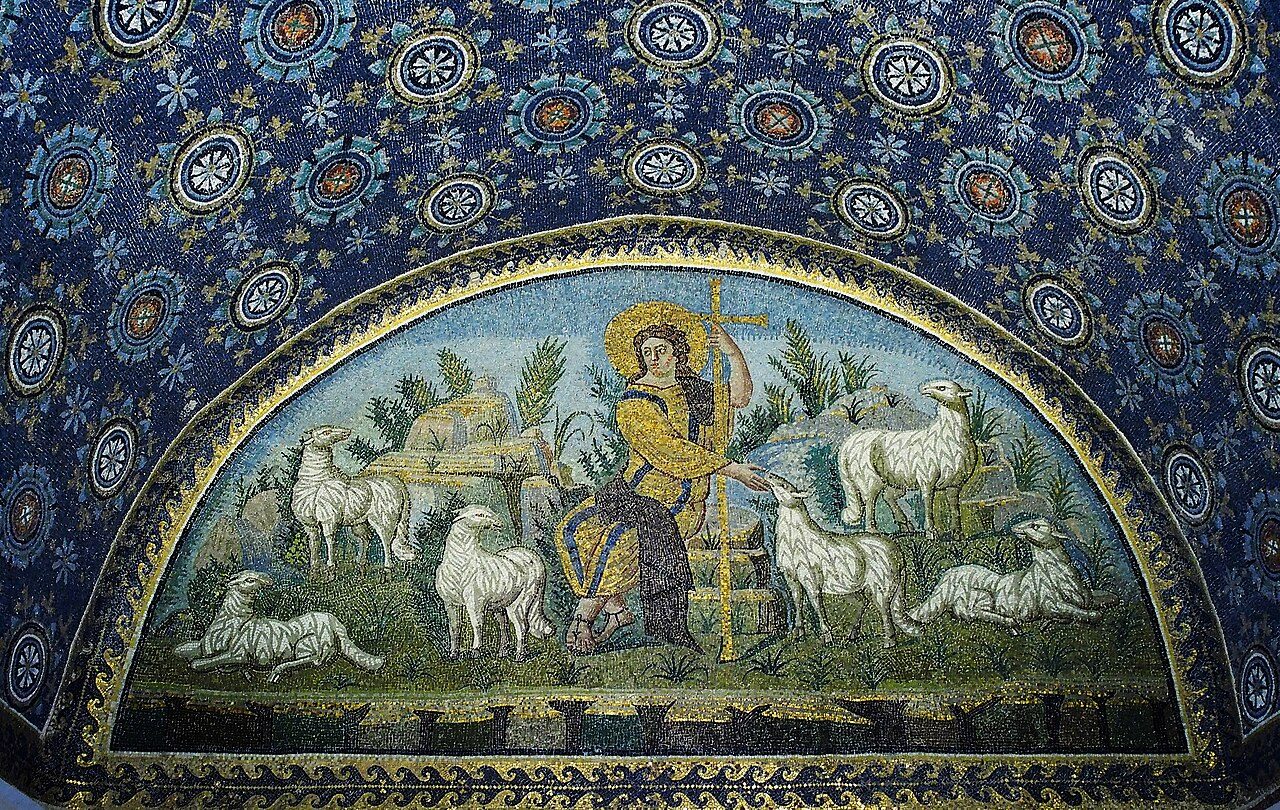
- Header photo: The Good Shepherd, mosaic, c. 425–450, Mausoleum of Galla Placidia, Ravenna. Photo: Petar Milošević, CC BY-SA 4.0, via Wikimedia Commons.