Read ·
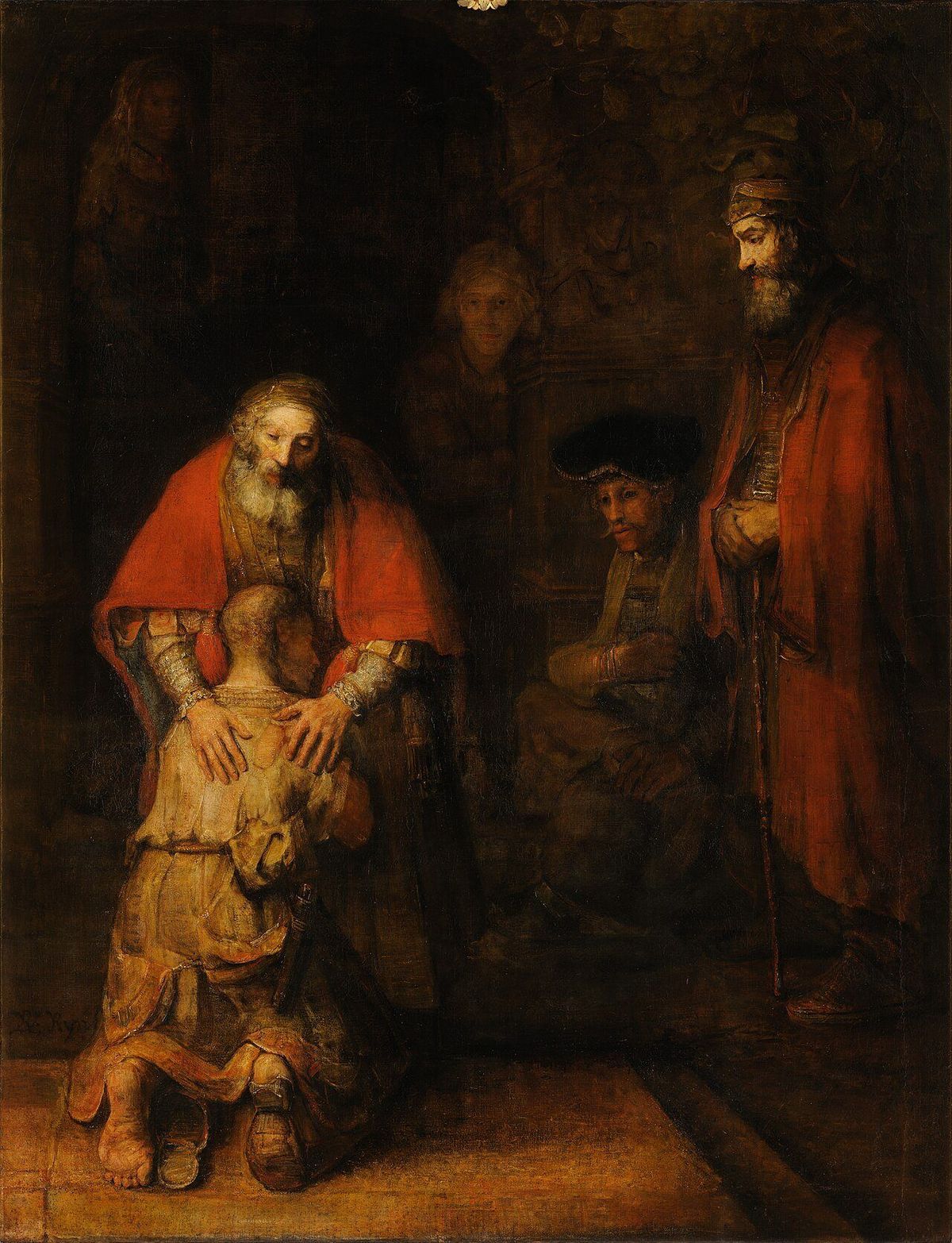
What Does the Parable of the Prodigal Son Mean?
The parable of the prodigal son is only twenty-two verses long, yet it may be the most retold story Jesus ever told. Early Christian writers argued over who the two sons are, and one of them turned the story into his own autobiography.
by VRSZ Editors · November 2, 2026 · 5 min read
The parable of the prodigal son has a simple plot. A younger son takes his inheritance early, wastes it in “a far country,” hits bottom feeding pigs, and walks home rehearsing an apology. His father runs to meet him before he can finish it. Then the older brother refuses to come in to the party. The prodigal son meaning seems obvious, but the earliest Christian interpreters found more in it than a lesson about forgiveness. They asked where the “far country” really is, who the father is, and why the story ends with an angry brother standing outside.
The passage: Luke 15:11–32
“A certain man had two sons: And the younger of them said to his father, Father, give me the portion of goods that falleth to me... And not many days after the younger son gathered all together, and took his journey into a far country, and there wasted his substance with riotous living... But when he was yet a great way off, his father saw him, and had compassion, and ran, and fell on his neck, and kissed him.”
The parable is the third in a row. Luke 15 opens with religious leaders complaining that Jesus “receiveth sinners, and eateth with them,” and Jesus answers with a lost sheep, a lost coin and a lost son.
Augustine: the far country is inside
Augustine of Hippo did not write a commentary on this parable so much as live inside it. His Confessions, written in the 390s, return to it more than once. In the first book he makes a startling point about the journey. Nobody leaves God by travelling: “it is not by our feet, nor by change of place, that we either turn from You or return to You.”
Then he asks the reader to look at the story again: “Or, indeed, did that younger son look out for horses, or chariots, or ships.” The far country, for Augustine, is a condition of the heart, distance measured in desire rather than miles. The same verse that describes the son’s departure gives him a line of praise for the father: “A kind Father when You gave, and kinder still when he returned destitute!”
In the third book, describing his own restless student years in Carthage, he puts himself in the pigsty. He was so far gone, he says, that he was “being even shut out from the very husks of the swine, whom with husks I fed.”
Tertullian: no father like this one
A couple of centuries earlier, Tertullian of Carthage set the parable beside the lost sheep and the lost coin to show how gladly God receives a sinner who repents. His question is direct: “Who is that father to be understood by us to be? God, surely: no one is so truly a Father; no one so rich in paternal love.”
And the welcome does not depend on how much the son has left: “He, then, will receive you, His own son, back, even if you have squandered what you had received from Him, even if you return naked — just because you have returned.”
The prodigal son meaning: who is the older brother?
By the fifth century, readers had several theories about the older son. Cyril of Alexandria, preaching through Luke’s Gospel, reported two of them. Some said the two sons were the angels and humanity. Others said the older son was Israel and the younger one the Gentiles. Cyril’s verdict was blunt: “With these explanations I do not agree.”
His reason is a careful one. The angels, Jesus says just a few verses earlier, rejoice over every sinner who repents, so they cannot be the brother who sulks outside the feast. Cyril points instead to the setting of the parable. It answers people who resent God’s generosity toward sinners, especially toward people who turn to God in old age or even on their deathbed. “Such complaints men sometimes give utterance too from an empty narrowness of mind, not conforming to the purpose of the universal Father.”
The father in the story does not share that narrowness. In Cyril’s words, God “greatly rejoices when He sees those who were lost obtaining salvation.” And he ends the sermon with a list of what such a father does: “He seeks those who were lost; He raises as from the dead those who had suffered the spiritual death.”
Two sons, one invitation
Read together, these writers cover both halves of the story. Augustine and Tertullian stand with the younger son, the one who left without moving his feet and came home with nothing in his hands. Cyril stands at the door with the older son, who never left the farm and still could not share his father’s joy.
The parable never says whether the older brother went in. Luke leaves him outside, with the father pleading. Each reader is left to decide which son they are, and whether they will join the feast.
Read it for yourself
Every verse of Luke 15:11–32 has its own commentaries on VRSZ. Follow the younger son from the far country back to his father’s arms, and hear what the early Church said at each step. Tap Luke 15:20 on VRSZ to start.
Luke xv. 20
20And he arose, and came to his father. But when he was yet a great way off, his father saw him, and had compassion, and ran, and fell on his neck, and kissed him.
Read the commentaries on Luke 15:20Know someone who would want to read this?
Sources quoted
- Augustine of Hippo, Confessions I.18.28 and III.6.11, trans. J. G. Pilkington (NPNF, 1st series, vol. 1), newadvent.org/fathers/110101.htm and newadvent.org/fathers/110103.htm.
- Tertullian, On Repentance 8, trans. S. Thelwall (ANF vol. 3), newadvent.org/fathers/0320.htm.
- Cyril of Alexandria, Commentary on Luke, Sermon 107, trans. R. Payne Smith (1859), tertullian.org/fathers/cyril_on_luke_10_sermons_99_109.htm.
- Luke 15, King James Version.