Of Interest ·
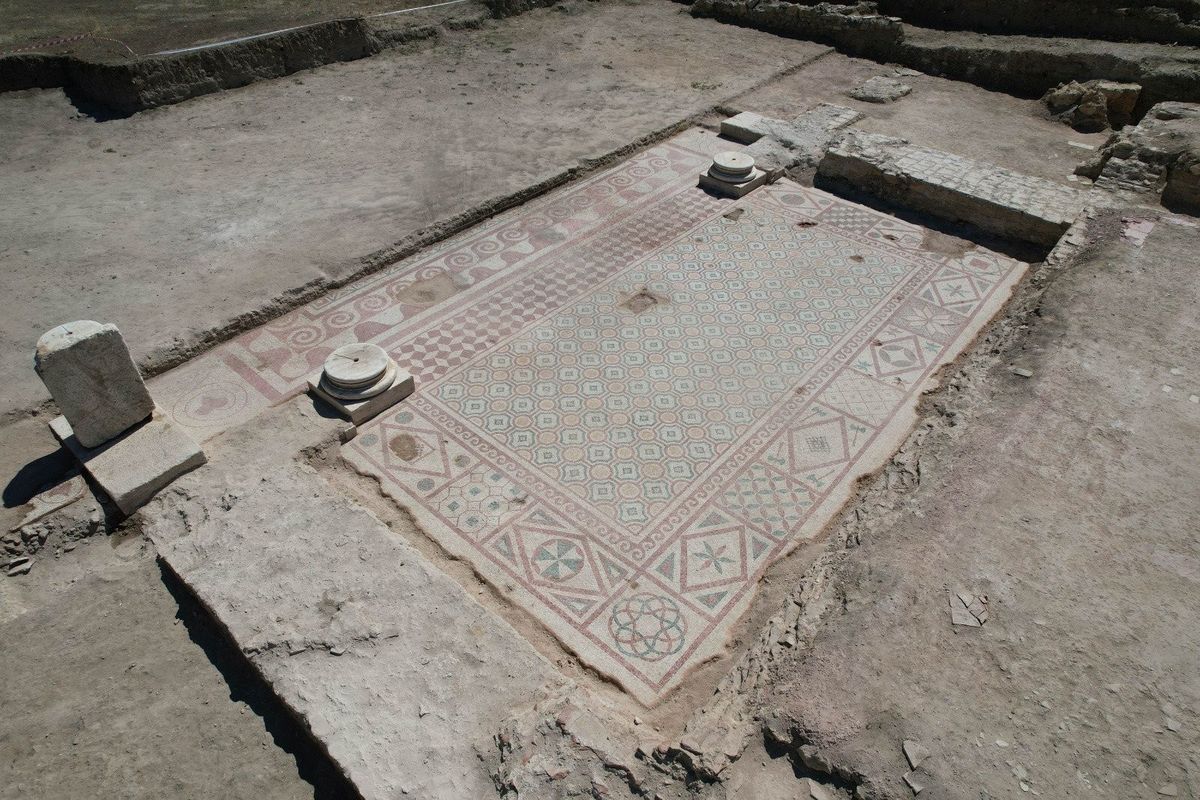
105 square meters of 4th-century mosaic uncovered in a basilica in Pompey’s city in northern Türkiye
At Pompeiopolis in Kastamonu, excavators have exposed a large geometric floor in the nave of a Roman basilica that later served the city’s Christians, along with a 1,800-year-old head of Eros.
by VRSZ Editors · October 22, 2026 · 4 min read
A floor in the nave
Türkiye’s Minister of Culture and Tourism, Mehmet Nuri Ersoy, announced the find on X (@MehmetNuriErsoy) on September 7, 2026. “During our work in the central nave of the basilica,” he wrote, “we uncovered approximately 105 square meters of floor mosaics dating to the fourth century A.D., consisting of geometric compositions and in very good condition.”
The ministry’s photographs show a carpet of panels in white, red and green-grey stone: rows of small rosettes, lozenges, scrolling wave borders and a circular rosette near one edge, set between the column bases that once divided the nave from the aisles. The minister singled out the floor’s size and its very good state of preservation.
The floor is not yet fully exposed. Excavation of the nave continues, and conservation of the mosaics uncovered this season has been completed, according to the minister and Anadolu Agency.
A city founded by Pompey
Pompeiopolis lies near the modern town of Taşköprü in Kastamonu province, on a hill called Zımbıllı Tepe above the Gökırmak, the river the ancients called the Amnias. It should not be confused with Soli-Pompeiopolis on the Mediterranean coast in Mersin. The Roman general Pompey founded the city around 65–64 BC after his eastern campaigns, and it grew into one of the leading cities of Paphlagonia, the region along Türkiye’s Black Sea hinterland, in the Roman imperial period.
Excavations at the site began in 2006. The current work is directed by Assoc. Prof. Mevlüt Eliüşük of Karabük University, with support from the ministry’s Heritage for the Future program. Recent seasons uncovered the city’s odeon in 2024 and an octagonal martyrion, a shrine built over the tomb or memory of a martyr, in 2025.
“We uncovered approximately 105 square meters of floor mosaics dating to the fourth century A.D., consisting of geometric compositions and in very good condition.”
Mehmet Nuri Ersoy · Türkiye’s Minister of Culture and Tourism, via Hürriyet Daily News
From law court to church
The basilica itself was first explored in 2025. According to the excavation team, its first phase dates to about AD 150–160, on the evidence of its architecture, stratigraphy and finds. Eliüşük has described it as originally a civic building used as a market hall and law court, the ordinary function of a Roman basilica.
Later it was rebuilt and its use changed. The team links that later phase to the Christianization of the city and to Pompeiopolis’s role as a bishop’s seat. The fourth-century mosaic floor in the nave belongs to this long story of reuse, though the excavators have not yet published a detailed account of when the building first served as a church.
The head of Eros
In a side room of the basilica known as a pastophorion, a chamber beside the apse used in churches to prepare and store the offerings, the team found a sculpted head of Eros, the Greek god of love, usually shown as a chubby winged boy. It dates to the second half of the 2nd century AD. Hürriyet Daily News and Arkeonews describe it as marble. The ministry’s photograph shows a child’s face with full cheeks and curled hair, worn and stained.
The head is older than the mosaic by some two centuries and belongs to the building’s Roman civic phase. How it came to rest in a room of the later church has not been explained.
Why it matters
Paphlagonia rarely features in the story of early Christianity, but its cities had bishops and churches like those elsewhere in Asia Minor. At Pompeiopolis a public hall of the Roman city appears to have been taken over for Christian worship and given a costly new floor, much as the Roman basilica form became the model for church buildings across the empire. The excavators expect more of the floor to come to light as the nave is cleared.
Read it for yourself
Open VRSZ, tap Psalm 26:8, and read what the early Christian writers said about loving the house where God’s honour dwells.
Psalm xxvi. 8
8LORD, I have loved the habitation of thy house, and the place where thine honour dwelleth.
Read the commentaries on Psalm 26:8Know someone who would want to read this?
Sources quoted
- Mehmet Nuri Ersoy (@MehmetNuriErsoy), post on X, September 7, 2026, x.com/i/status/2096856153984565703.
- Yasemin Kalyoncuoğlu, “Kastamonu Pompeiopolis Antik Kenti’nde 105 metrekarelik zemin mozaikleri açığa çıkarıldı,” Anadolu Ajansı, September 7, 2026.
- “105 square meters of mosaics unearthed at Pompeiopolis,” Hürriyet Daily News, September 2026; Hürriyet Daily News report on the 2025 basilica season, October 29, 2025 (Mevlüt Eliüşük).
- Oguz Buyukyildirim, “105-Square-Meter Mosaic and 1,800-Year-Old Eros Head Unearthed at Pompeiopolis,” Arkeonews, September 7, 2026.
- Psalm 26:8, King James Version.
- Header photo: the geometric mosaic floor in the basilica nave, Republic of Türkiye Ministry of Culture and Tourism, via @MehmetNuriErsoy.