Of Interest ·
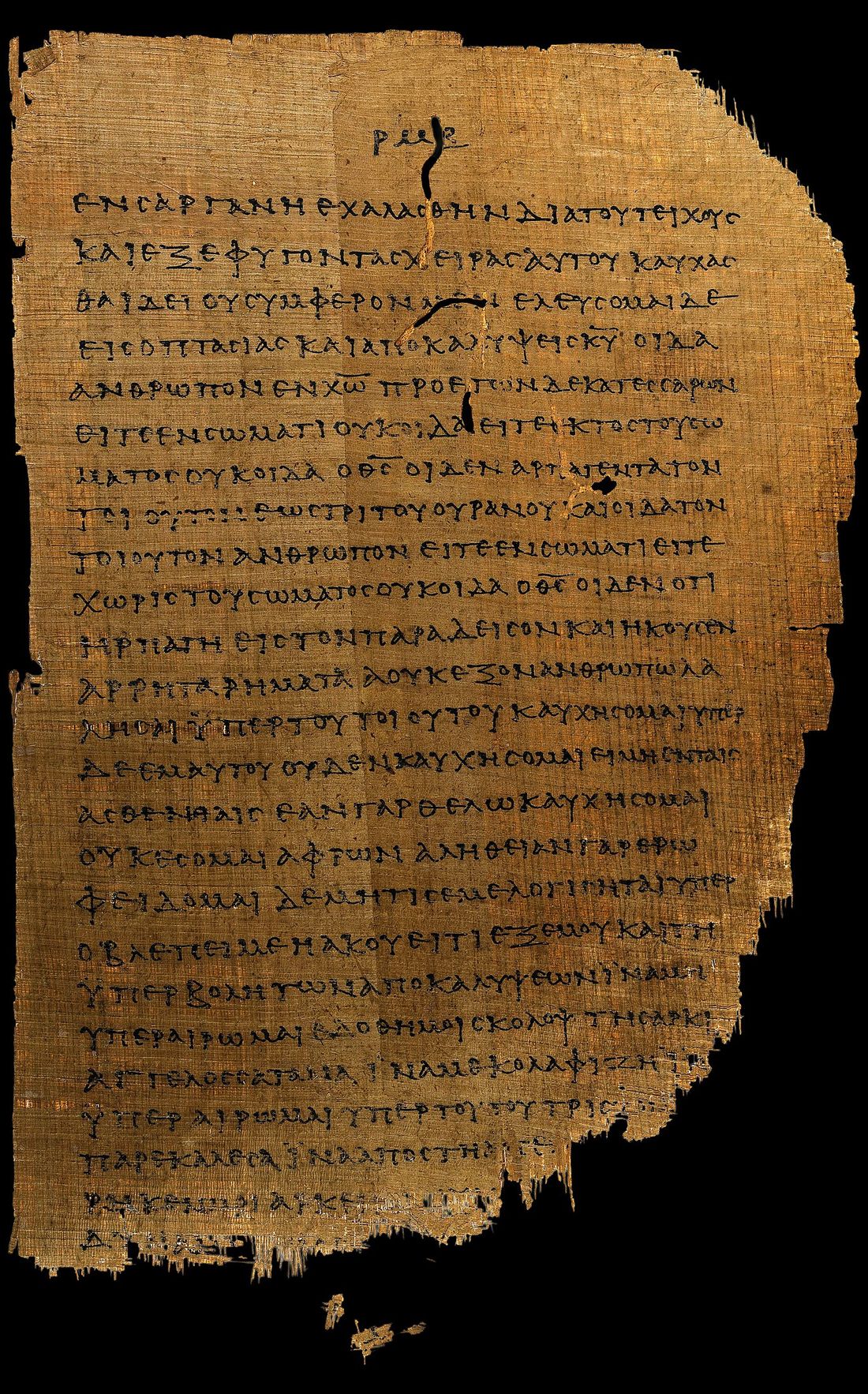
Was 2 Corinthians originally more than one letter?
In the Fall 2026 Biblical Archaeology Review, Brent Nongbri takes up an old question about the seams in 2 Corinthians. The partition theory is a hypothesis drawn from those seams. Every surviving ancient manuscript presents the letter as one continuous text.
by VRSZ Editors · November 15, 2026 · 4 min read
A change of tone
Midway through Paul’s second letter to the church at Corinth, the voice turns.
In the earlier chapters, Paul writes with warmth and confidence. “Great is my boldness of speech toward you, great is my glorying of you: I am filled with comfort, I am exceeding joyful in all our tribulation” (2 Corinthians 7:4). He celebrates the Corinthians’ repentance and says he trusts the community.
Then, at the start of chapter 10, the tone changes with no real transition. Chapters 10 through 13 are sharp and sarcastic. Paul defends his status as an apostle and chastises the same church for grave religious failings.
That break, between 2 Corinthians 9 and 10, is what scholars call a literary seam. In a Fall 2026 Biblical Archaeology Review article, “Cobbling Together 2 Corinthians,” the biblical scholar Brent Nongbri treats it as the strongest piece of evidence that 2 Corinthians may not have begun as a single letter.
An old question
The point is not that Paul did not write the letter. Second Corinthians belongs to the seven New Testament letters whose authorship is undisputed: Romans, 1 Corinthians, 2 Corinthians, Galatians, Philippians, 1 Thessalonians and Philemon. The question is whether the text we have is one continuous letter, or a compilation of more than one of Paul’s letters, later edited together.
That idea is known as partition theory. Second Corinthians is the New Testament epistle most often thought to be a combination of two or more separate writings. The letter has abrupt shifts in tone and topic, awkward seams from one section to the next, and passages that seem to assume different settings. Those are the usual marks of a text that has been pieced together.
Lauren K. McCormick summarized Nongbri’s argument for Bible History Daily on November 11, 2026.
What the manuscripts show
It is important to be clear about the evidence, and about its limits.
Every ancient copy of 2 Corinthians that has been preserved presents Paul’s text as one continuous letter. None of them preserves the parts as separate missives. The earliest of those copies, McCormick notes, probably dates to no earlier than 150 years after Paul wrote, by which time the writings had already been gathered into a single letter. The case for more than one original letter is therefore made from the text itself, not from a manuscript that still shows the letters apart.
The partition theory remains a hypothesis, drawn from those internal seams, especially the shift at chapter 10. It is a serious reading of a real feature of the letter. It is not a fact established by the surviving copies.
Pasted rolls
Nongbri also asks a practical question. Did people in antiquity actually combine separate letters, and could the pieces end up out of chronological order?
There was no organized postal service for ordinary writers. “You would find someone who was going to the city where you wanted to send your letter,” Nongbri writes, “and you would give them your folded or rolled-up letter with the addressee’s name written on the outside and hope for the best.” Weather, shipwreck, forgetfulness, or any number of other problems might delay a letter, or keep it from arriving at all. Letters were sent, received and gathered at different times, and they were often read out of order.
When a letter did arrive, the recipient might throw it away or save it. Those who saved letters sometimes pasted several from the same person into a single roll. There is a Greek term for that kind of collection, a tomos synkollesimos, a “pasted roll.” Letters in such a roll were sometimes joined in the order they were received, not in the order they were written.
A later parallel comes from the letters attributed to Pachomius, a fourth-century Egyptian monk. They survive in a Latin translation of eleven letters. Over the last century, very early manuscripts of those letters have been found in Egypt, and they divide the letters differently. The order changed somewhere in the process of transmission, perhaps in a way similar to Paul’s letters.
“You would find someone who was going to the city where you wanted to send your letter, and you would give them your folded or rolled-up letter with the addressee’s name written on the outside and hope for the best.”
Brent Nongbri · via Bible History Daily, Nov 11, 2026
Read it for yourself
None of this takes 2 Corinthians away from the Church. Christians have received it as one letter, and that is how every surviving ancient copy presents it. What the seams can still do is help a reader notice the letter’s turns, the comfort of chapter 7 and then the hard defense that follows in chapters 10 through 13, and read each part on its own terms.
Open VRSZ, tap 2 Corinthians 7:4, and read what Christian writers have said about Paul’s confidence in the church at Corinth. Then keep reading into chapter 10, and listen for the change yourself.
2 Corinthians vii. 4
4Great is my boldness of speech toward you, great is my glorying of you: I am filled with comfort, I am exceeding joyful in all our tribulation.
Read the commentaries on 2 Corinthians 7:4Know someone who would want to read this?
Sources quoted
- Lauren K. McCormick, “Unpacking Paul’s New Testament Letters,” Bible History Daily, Biblical Archaeology Society, November 11, 2026, summarizing Brent Nongbri, “Cobbling Together 2 Corinthians,” Biblical Archaeology Review, Fall 2026, biblicalarchaeology.org.
- 2 Corinthians 7:4; 2 Corinthians 10:1 to 13:14, King James Version.
- Header photo: Papyrus 46 (P.Mich.inv. 6238), folio 142 recto, University of Michigan, containing 2 Corinthians 11:33 to 12:9. Public domain, via Wikimedia Commons.