Of Interest ·
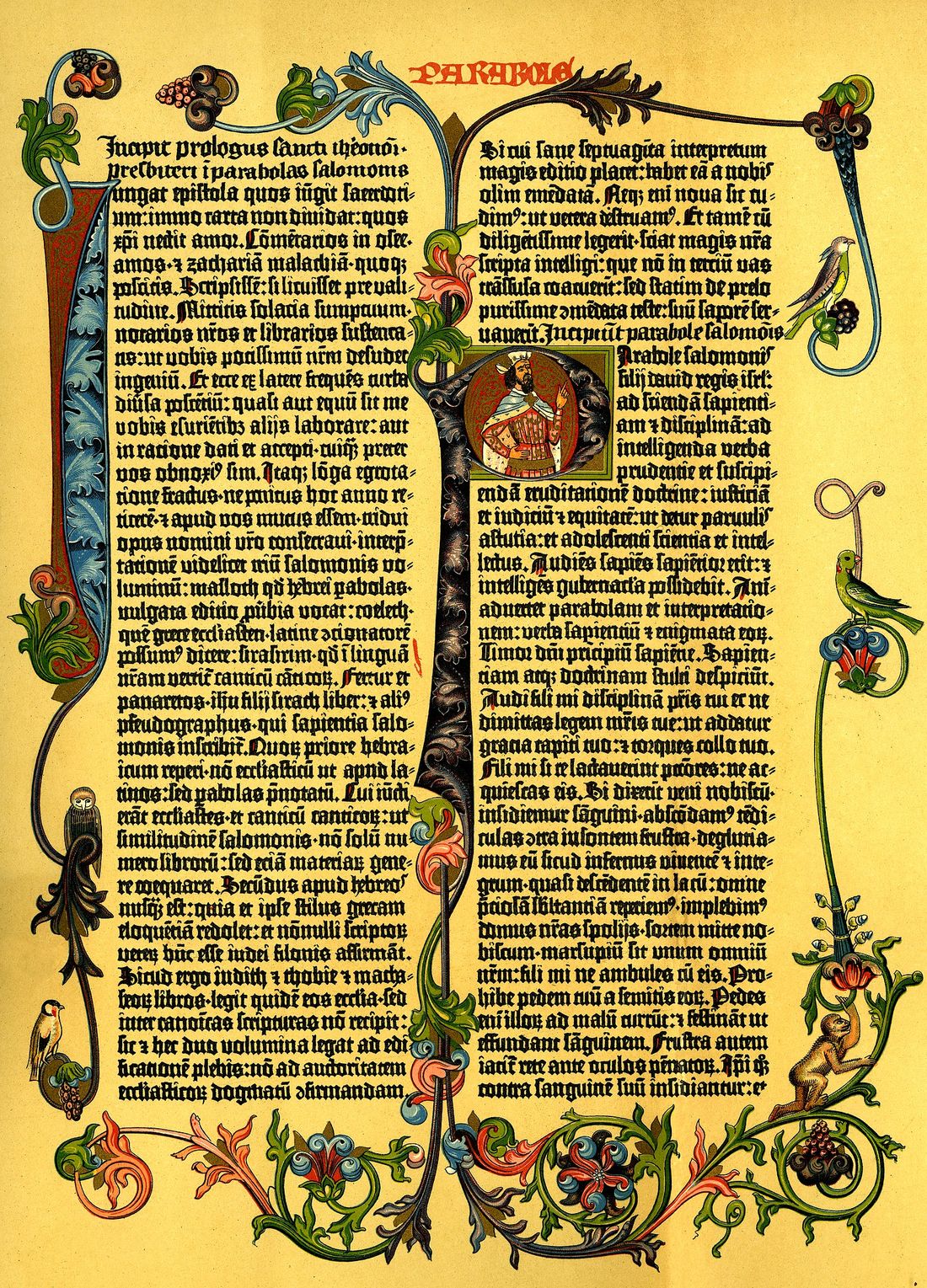
The world’s largest printed Bible page, at Strasbourg Cathedral
A reproduction of a Gutenberg Bible page, five meters wide and 7.20 meters high, was printed in Mainz in spring 2025 and shown at Strasbourg Cathedral from May to August 2026. The International Gutenberg Society is looking for new hosts.
by VRSZ Editors · November 15, 2026 · 3 min read
A page the size of a wall
On May 9, 2026, Europe Day, the world’s largest printed Bible page was presented at Strasbourg Cathedral. The International Gutenberg Society in Mainz calls it a monumental reproduction of a page from the 42-line Gutenberg Bible, and the largest printed Bible page ever produced. It measures five meters across and 7.20 meters high.
It was printed in spring 2025 in Mainz, the city where Johannes Gutenberg worked, with partners and members of Strasbourg’s Espace Européen Gutenberg. The Strasbourg showing was its first public presentation in that city, and it formed part of the Gutenberg anniversary celebrations.
The exhibition stood in the cathedral from May 9 until August 31, 2026. The run is over. The society is now inviting churches, museums and libraries to host the page, and it asks interested institutions to write to info@gutenberg-gesellschaft.de.
Two cities of the press
The choice of Strasbourg was not an accident. The Gutenberg Society points to a long tie between the two cities. In the 1430s and early 1440s, Gutenberg worked in Strasbourg on technical processes that are regarded as important precursors to his later invention. Back in Mainz, he produced the 42-line Bible, the first major book in Europe printed with movable metal type, and a masterpiece of early printing.
The monumental page had already been shown once before it reached the cathedral. It was first presented at the opening of the Rhineland-Palatinate Cultural Summer, then exhibited in Mainz Cathedral. Its making had already drawn international attention. The Strasbourg installation was overseen by Markus Kohz, a board member of the International Gutenberg Society, who initiated the project.
Printed by a car, and by footsteps
The method was as striking as the scale. Twelve computer-milled wooden printing blocks were assembled to recreate the historic printing form. The blocks were inked by hand.
To put enough pressure on a surface that large, a passenger car was slowly driven across the form. In a second printing, the public took part. Visitors walked across the plates, and their collective weight supplied the pressure.
On Europe Day, the Espace Européen Gutenberg also held a public screen-printing workshop at Place du Château, in front of the cathedral, on the Gutenberg monuments in Mainz and Strasbourg. Dr. Carina Weißmann, managing director of the International Gutenberg Society, took part in a live printing activity there.
“To apply the necessary pressure to the enormous printing surface, a passenger car was slowly driven across the printing form.”
International Gutenberg Society · Mainz, on the spring 2025 printing
A shared inheritance
The presentation in Strasbourg is part of a larger project by the Espace Européen Gutenberg, which works to preserve and communicate the history of printing and graphic media. Its long-term aim is a “Centre Gutenberg” in Strasbourg, a European center for the printing arts, book history, typography and graphic innovation.
After the page was presented, Strasbourg’s Lord Mayor, Nino Haase, gave trial prints of it as official gifts to Jean-Luc Lienard, vicar general of the Archdiocese of Strasbourg; Carole Wenner, a deputy mayor of Strasbourg responsible for libraries and the promotion of books; and Guy Tinsel, president of the Espace Européen Gutenberg. At a reception that followed, Tinsel answered with a commemorative banner meant to mark the tie between the two Gutenberg cities.
The society describes the project as a sign of Europe’s shared printing heritage, and of Gutenberg’s lasting importance for the spread of knowledge, education and cultural exchange.
The word that stands
Movable type made it possible to print a whole Bible, and to print it again. A page five meters wide is a show of that craft at a scale few people will ever see in person. The Strasbourg run has ended, but the page itself can travel, and the text it magnifies has been traveling a great deal longer.
“The grass withereth, the flower fadeth: but the word of our God shall stand for ever” (Isaiah 40:8).
Open VRSZ, tap Isaiah 40:8, and read what Christian writers have said about the word that does not fade.
Isaiah xl. 8
8The grass withereth, the flower fadeth: but the word of our God shall stand for ever.
Read the commentaries on Isaiah 40:8Know someone who would want to read this?
Sources quoted
- International Gutenberg Society, “The World’s Largest Printed Bible Page at Strasbourg Cathedral,” gutenberg-gesellschaft.de.
- Isaiah 40:8, King James Version.
- Header photo: The opening of the Book of Proverbs, with Jerome’s prologue, in a hand-illuminated copy of the 42-line Gutenberg Bible (mid-fifteenth century, Mainz). This is a page from the original book, not the 2025 monumental print. Public domain, via Wikimedia Commons.