Read ·
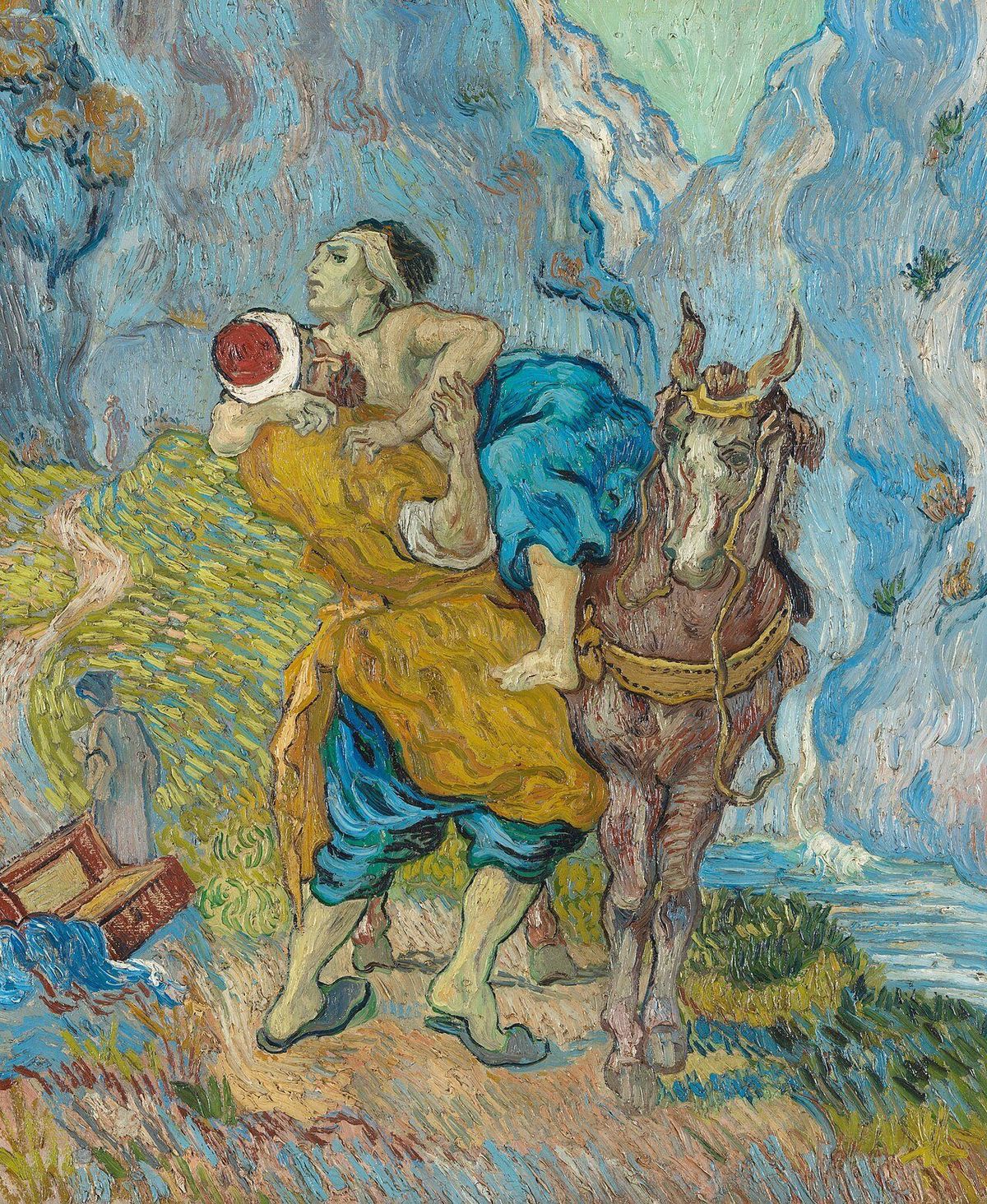
What Does the Parable of the Good Samaritan Mean?
A lawyer asks Jesus who counts as his neighbor, and gets a story in which the hero belongs to the wrong people. Early Christian writers saw two things in the parable of the Good Samaritan: a command about mercy, and a portrait of Christ himself.
by VRSZ Editors · November 4, 2026 · 5 min read
The parable of the Good Samaritan is so familiar that its main character has become a common noun. “Good Samaritan laws” protect people who stop to help at accidents. But the meaning of the Good Samaritan for its first hearers depended on how much Jews and Samaritans distrusted each other. A priest and a Levite, the people most expected to help, walk past. The one who stops is an outsider. Early Christian interpreters kept that shock in view, and some added a second layer: the Samaritan who rescues the wounded man looks a lot like Jesus.
The passage: Luke 10:25–37
“And, behold, a certain lawyer stood up, and tempted him, saying, Master, what shall I do to inherit eternal life?” When Jesus points him to the commandments to love God and neighbor, the lawyer, “willing to justify himself,” asks a follow-up question: “And who is my neighbour?”
Jesus answers with the story of a man who “went down from Jerusalem to Jericho, and fell among thieves.” A priest passes by on the other side, then a Levite. “But a certain Samaritan, as he journeyed, came where he was: and when he saw him, he had compassion on him.” At the end Jesus turns the lawyer’s question around and asks which of the three “was neighbour unto him that fell among the thieves.” The answer: “He that shewed mercy on him.” Then: “Go, and do thou likewise.”
Augustine: the insult Jesus let stand
Augustine’s most memorable comment on this parable is not in a sermon on Luke at all. It comes in his lectures on John’s Gospel, at the point where Jesus’ opponents say, “Say we not well that thou art a Samaritan, and hast a devil?” (John 8:48).
Augustine noticed something about Jesus’ reply. Two insults were thrown, and only one was answered: “He denied the one, but not the other.” Jesus said, “I have not a devil.” He never said, “I am not a Samaritan.”
Why let that one stand? Augustine’s answer rests on what he took the name itself to mean: “For Samaritan means keeper.” The Psalms call God the keeper of Israel, who “neither slumbers nor sleeps.” So when Jesus is called a Samaritan, Augustine hears an accidental truth. He then retells the parable in a few lines: “A certain Samaritan came up — He who is our Keeper.” The rescuer “did a neighbor’s part to one whom He did not account an alien.”
Who is my neighbor? The Good Samaritan meaning in the early Church
Augustine did not let that Christ-centered reading cancel the plain command. In On Christian Doctrine, written for people learning to interpret Scripture, he takes the lawyer’s question head on and concludes that “it is clear that every man is to be considered our neighbor.” Neighbor is not a category you can shrink to fit your comfort.
He then makes the same move he made with the word Samaritan, from the other direction. If a neighbor is whoever shows mercy, then “even God Himself, our Lord, desired to be called our neighbor,” since Christ pictured himself as the one who helped the man left half dead by the road. Reading the Samaritan as Christ does not excuse the reader from stopping. It shows who stopped first.
Cyril of Alexandria: titles are not enough
Cyril of Alexandria, preaching through Luke in Egypt in the fifth century, focused on the contrast between the characters. The priest and the Levite had status, learning and religious office, and none of it helped the man in the ditch. “But one of another race, a Samaritan, fulfilled the law of love.”
Cyril’s point was aimed at the lawyer and at anyone proud of a religious title. Rank, he said, is useless without deeds to match it. Then he gave the parable its punchline: “a crown of love is being twined for him who loves his neighbour: and he proves to be a Samaritan.” To show that this was no accident, he cited Peter’s words in Acts that God shows no partiality, and accepts from every nation whoever fears him.
The road from Jerusalem to Jericho
Both readings, the moral and the Christ-centered, were common in the early Church, and the Fathers rarely saw them as rivals. If the Samaritan is Christ, then the wounded traveler is every human being, and the command “Go, and do thou likewise” asks the rescued to become rescuers.
The lawyer wanted a boundary: who is my neighbor, and who is not? The parable gives him a mirror instead. The question that matters is not who qualifies for help, but who will act like a neighbor to the next person lying by the road.
Read it for yourself
Each verse of Luke 10:25–37 has its own commentaries on VRSZ. Walk the road from Jerusalem to Jericho with Augustine, Cyril and other early writers, one verse at a time. Tap Luke 10:33 on VRSZ to start.
Luke x. 33
33But a certain Samaritan, as he journeyed, came where he was: and when he saw him, he had compassion on him,
Read the commentaries on Luke 10:33Know someone who would want to read this?
Sources quoted
- Augustine of Hippo, Tractates on the Gospel of John 43.2, trans. John Gibb (NPNF, 1st series, vol. 7), newadvent.org/fathers/1701043.htm.
- Augustine of Hippo, On Christian Doctrine I.30, trans. James Shaw (NPNF, 1st series, vol. 2), newadvent.org/fathers/12021.htm.
- Cyril of Alexandria, Commentary on Luke, Sermon 68, trans. R. Payne Smith (1859), tertullian.org/fathers/cyril_on_luke_07_sermons_66_80.htm.
- Luke 10:25–37; John 8:48–49, King James Version.