News ·
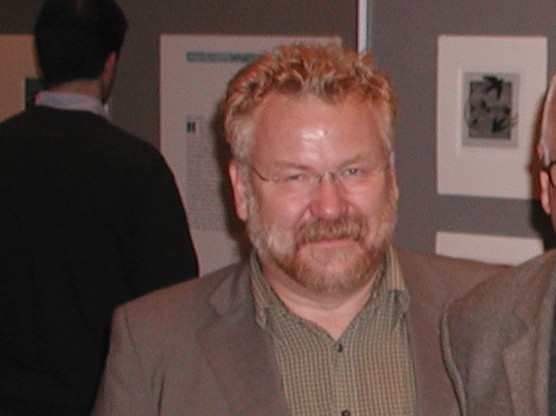
He spent his life making Bibles easier to read. Klaus Krogh has died at 74
The Danish designer behind the Bible Sans, Bible Serif and Bible Slab typefaces, the Comfort Print Bibles and the dyslexia-friendly Grace typeface died suddenly on October 5. His studio, 2K/Denmark, set Bibles for publishers in dozens of countries.
by VRSZ Editors · October 28, 2026 · 5 min read
A sudden death
Klaus Krogh, the Danish Bible designer and typographer who founded the Aarhus studio 2K/Denmark, died suddenly on Monday, October 5, at the age of 74, the company announced. He is survived by his wife, Liv, two daughters and two grandchildren.
“Two of Klaus’s great passions, typographic design and the Word of God, found their perfect union in Bible design and typesetting,” said the company’s statement, signed by chief executive Sune Andersen and by Lea Rathje, chair of the board and Krogh’s daughter. “He was a true force of nature, and he poured his whole heart into every single project.” Krogh had led the company until recently and still came to the office in Aarhus each day. The statement said 2K would “continue his life’s work: to make the next Bible our best one yet.”
Christianity Today, in a tribute by Taylor Berglund published October 26, gave the date of death as October 6.
From a bedroom wall to the Bible Society
A Copenhagen native, Krogh had dyslexia as a child. “The words seemed to bounce on the page,” WORLD reported in a 2025 profile. At 13 he drew his own alphabet and used it to write Bob Dylan’s name on his bedroom wall. “I was predestined to do what I’m doing,” he told the magazine.
From 1982 to 1987 he worked as a graphic designer and production manager for the Norwegian Bible Society. In 1987 he and his wife founded their own studio, first called 2Krogh. “We couldn’t make Bibles with a company [that sounded like it was] named 2 Crooks, so we had to change it again,” he told Christianity Today. As 2K/Denmark, the firm came to design and typeset Bibles for customers in more than 43 countries, among them HarperCollins Christian Publishing and the United Bible Societies.
Typefaces made for thin paper
Bible pages are thin, the text is long and the type is small, and Krogh designed for those limits. 2K’s Bible Sans, its most space-efficient face, has a large x-height. Bible Slab has a low-contrast design that, the company says, “makes it withstand even the toughest printing conditions” and allows “a fully readable Bible in no more than 600 pages.” Bible Serif was shortlisted for type design at the Creative Circle Awards in 2017. Krogh told Publishers Weekly that the right typeface could save “20% of the total page count and a lot of trees.”
His best-known commission came from HarperCollins Christian Publishing, whose Zondervan and Thomas Nelson imprints asked 2K for typefaces for the NIV, KJV and NKJV. Melinda Bouma of Zondervan, who met Krogh in 2015, wrote that 2K delivered 24 individual fonts across the three typefaces, which she called “the largest known font commission in history.” The first of the resulting Comfort Print Bibles, a Thomas Nelson KJV, appeared in spring 2017, followed by NIV and NKJV editions.
“Decades ago, American Bibles weren’t much to look at,” Krogh told Publishers Weekly, describing tiny type and verses crammed into long paragraphs on thin paper. “Then publishers realized that building better Bibles would entice people to not only buy Bibles but to read them.”
A Bible for dyslexic readers
The idea for his last major project came, Christianity Today reported in 2024, when a woman approached him at an Evangelical Christian Publishers Association event in Nashville. Krogh spent five years developing Grace, a typeface for readers with dyslexia, with the research department of Cambridge University. Its letters are weighted toward the bottom. Grace Bibles use 11-point type, no bold or italics, no footnotes, and sections of no more than 11 lines.
Lifeway’s B&H Publishing released the CSB Grace Bible for Kids, described as the first dyslexia-friendly children’s Bible, and then the CSB Grace Bible in February 2025. Crossway published the ESV Holy Bible: Dyslexia-Friendly Edition on January 9, 2025, “developed in partnership with Klaus Krogh of 2K and Cambridge University’s research department,” with 11-point type and colored overlays in 30 color options. Krogh made Grace available beyond a single publisher, and the British publisher Sarah Grace Publishing adopted it. “I’d like to have it out in all translations,” he said in 2024. “That’s my faith, to use whatever God gave me to enrich other people’s lives.”
Mary Wiley of B&H told Publishers Weekly of “kids crying with joy because they could finally read the Bible. It’s changing people’s lives.”
“Unreadable Bibles are of no use”
Krogh spoke plainly about why the work mattered to him. “I am a Christian, I read the Bible every day,” he said on the Bible Gateway Podcast in 2022. “If you are about to publish a Bible, you have no excuse not to make it readable. Unreadable Bibles are of no use. That’s salt without power, so what can you use it for?” He described 2K’s mission as lowering “the thresholds for more people to read more in their Bible because we know it changes lives.”
He kept working into his seventies. In 2025 he told WORLD: “I’m a young man… Look at the Bible. How old did they get? Seven, eight hundred years? I’ve only started.” His recent projects included The Majestic Illustrated Bible, published by FaithWords in spring 2026 with modernized woodcuts from a German Bible of 1561, and a typeface for Ascension’s forthcoming Liturgy of the Hours, Second Edition. He also sat on a keynote panel on accessible publishing at the Protestant Church-owned Publishers Association’s 2026 gathering.
“Unreadable Bibles are of no use. That’s salt without power.”
Klaus Krogh · Bible Gateway Podcast, May 18, 2022
Tributes
Publishers across traditions paid tribute. Ascension, the Catholic publisher, said in a statement that Krogh “understood that these books were more than functional objects; they were vessels through which people could encounter God more deeply. For that, Klaus cared about every single detail. He knew what was at stake.” It closed: “May Klaus rest in the peace of Christ.”
Andy McLean of B&H called him “a titan in our industry, as well as a cherished ministry partner.” Daisy Blackwell Hutton of Hachette Nashville called him the “single most inspiring and visionary individual I have met over the course of my career in Christian publishing.” Bible reviewer Tim Wildsmith, quoted by Christianity Today, said Krogh “devoted his life to making God’s Word more readable” and “leaves behind an incredible legacy.”
In an Ascension video, Krogh once described what letters could do: “Letters are capable of creating beautiful words, words that carry everything that is difficult, important, and even holy, through time and space.”
Read it for yourself
Open VRSZ, tap Habakkuk 2:2, and read what the commentators say about making the written word plain enough to read at a glance.
Habakkuk ii. 2
2And the LORD answered me, and said, Write the vision, and make it plain upon tables, that he may run that readeth it.
Read the commentaries on Habakkuk 2:2Know someone who would want to read this?
Sources quoted
- 2K/Denmark, statement on the death of Klaus Krogh, signed by Sune Andersen and Lea Rathje, LinkedIn, October 2026.
- Cathy Lynn Grossman, obituary of Klaus Krogh, Publishers Weekly, October 7, 2026.
- Taylor Berglund, tribute to Klaus Krogh, Christianity Today, October 26, 2026.
- Ascension, statement on the death of Klaus Krogh, Exton, Pennsylvania, October 7, 2026.
- Bekah Bernhardt, profile of Klaus Krogh, WORLD, April 17, 2025.
- Rachel Pfeiffer, report on the Grace typeface, Christianity Today, November 13, 2024.
- Melinda Bouma, on the making of Comfort Print, 2K/Denmark; Bible Gateway Blog, 2017.
- “Designing the Word, with Klaus Krogh,” Bible Gateway Podcast, May 18, 2022.
- 2K/Denmark typeface pages for Bible Sans, Bible Serif and Bible Slab.
- Crossway, ESV Holy Bible: Dyslexia-Friendly Edition, product information, 2025.
- Habakkuk 2:2, King James Version.
- Header photo: Klaus Erik Krogh at the Church of Norway’s General Synod (Kirkemøtet), 2005. Kirkens informasjonstjeneste (kirken.no), CC BY 2.5, via Wikimedia Commons (cropped).