News ·
Did Josephus record that Jesus appeared alive on the third day? A new study says he may have
A study comparing four ancient versions of the famous passage on Jesus by the first-century Jewish historian argues that Josephus recorded the disciples’ report that Jesus appeared to them alive after the crucifixion.
by VRSZ Editors · October 29, 2026 · 6 min read
A new look at an old witness
A new study argues that Flavius Josephus, the most important Jewish historian of the first century, may have recorded that the followers of Jesus reported he had appeared to them alive on the third day after his crucifixion.
The study, “The Testimonium Flavianum in Four Transmission Lines: Greek, Latin, Arabic, and Syriac,” is by Jesús Fernández-Pedrera Correa, a researcher based in Barcelona. It was posted to the open research archive Zenodo in August 2026 and forms part of his book project The Historical Jesus Under Scrutiny. This week it drew wide attention online and was reported by the Daily Mail and the New York Post.
Who Josephus was
Josephus was born in Jerusalem around AD 37, a few years after the crucifixion, into a priestly family. He commanded Jewish forces in Galilee in the revolt against Rome, was captured, and spent the rest of his life in Rome writing the history of his people. His Jewish War and Jewish Antiquities are among our main sources for Judea in the time of Christ. They describe Herod, Pontius Pilate, the high priest Caiaphas and John the Baptist.
Josephus never became a Christian. That is why his short paragraph on Jesus, in book 18 of the Antiquities (18.63–64), finished around AD 93–94, has been studied so closely. It is known as the Testimonium Flavianum, the “testimony of Flavius.” In William Whiston’s classic 1737 translation of the Greek, it describes Jesus as “a wise man” and “a doer of wonderful works.” It records that Pilate “condemned him to the cross,” and it continues: “those that loved him at the first did not forsake him; for he appeared to them alive again the third day.”
Four versions, side by side
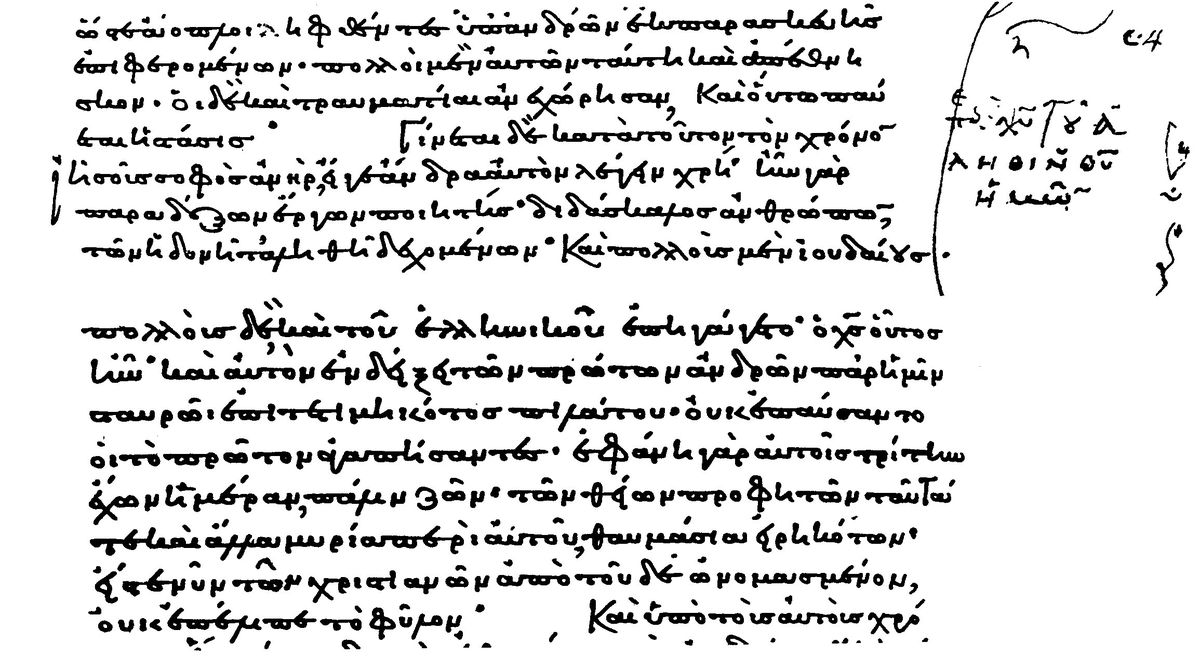
Many scholars have held that Josephus wrote a paragraph about Jesus that Christian copyists later added to. The question is what he originally wrote. The Greek manuscripts all carry essentially the same text, and the oldest of them, Codex Ambrosianus F 128 in Milan, pictured above, dates from the 11th century. So Fernández-Pedrera set the Greek beside three other ancient lines of transmission:
*Latin. St. Jerome translated the passage in his Lives of Illustrious Men (c. 392). Where the Greek says “he was the Christ,” Jerome writes credebatur esse Christus*, “he was believed to be Christ,” and he keeps the appearance: “he appeared to them the third day alive.”
*Arabic.* Agapius, a 10th-century bishop of Hierapolis in Syria, gave the passage in his world history, published by the scholar Shlomo Pines in 1971. In this version, Jesus’ disciples “reported that he had appeared to them three days after the crucifixion, alive,” and Jesus was “perhaps the Messiah, concerning whom the prophets have recounted wonders.”
*Syriac.* The 12th-century chronicle of Michael the Syrian, patriarch of the Syriac Orthodox Church, says Jesus “was thought to be the Messiah,” and it also retains the appearance.
“He appeared to them”
The study’s main finding concerns the line on the resurrection. Agapius’ Arabic presents the appearance as something the disciples reported. Fernández-Pedrera notes that this is the way Josephus elsewhere writes about what other groups and teachers claimed. That pattern, he writes, “is consistent with an original notice of the claim — Josephus reporting that the followers of Jesus said he had appeared to them.” In the Greek copies that have come down to us, the report was later filled out into a statement of the event, together with an appeal to the prophets.
He calls this reconstruction “plausible” and “supported by the Arabic form.” On his reading, the evidence supports an authentic core of the resurrection notice, though its exact original wording cannot now be fixed.
“Those who had loved him at first continued to the end, for he appeared to them the third day alive.”
Jerome · Lives of Illustrious Men 13, rendering Josephus
What else the study finds
The study’s firmest result concerns the phrase “He was the Christ.” Jerome’s Latin, Agapius’ Arabic and Michael’s Syriac all soften it, and Josephus himself later refers to “James, the brother of Jesus, who was called Christ” (Antiquities 20.200). Fernández-Pedrera concludes that Josephus’ original wording here was more reserved than the received Greek, closer to Jerome’s “he was believed to be Christ.”
He also argues that the passage’s closing words are Josephus’ own: “the tribe of Christians, so named from him, are not extinct at this day.” The core of the paragraph, on his reading, attests that Jesus lived, taught, drew many followers, was crucified under Pontius Pilate, and was reported by his disciples to have appeared to them alive.
Why it matters for Christians
For believers, the study’s argument is striking. A Jewish historian in Rome, a member of a priestly family who never joined the Church, would have written within a lifetime of the events that Jesus’ followers did not abandon him and that they reported he appeared to them alive on the third day.
That is the Easter proclamation as the New Testament records it. On the evening of the first Easter, the disciples greeted the two travelers returning from Emmaus with the words “The Lord is risen indeed, and hath appeared to Simon” (Luke 24:34). St. Paul handed on what he had received: that Christ “rose again the third day according to the scriptures: and that he was seen of Cephas, then of the twelve” (1 Corinthians 15:4–5). At Pentecost St. Peter told the crowd in Jerusalem, “This Jesus hath God raised up, whereof we all are witnesses” (Acts 2:32).
The Church has long treasured this passage. Eusebius of Caesarea quoted it in full in his Church History (1.11) around 324, and St. Jerome carried it into Latin. If the new study is right, an outside historian of the apostles’ own era took note of the witness they gave.
An ongoing conversation
The Testimonium remains one of the most discussed passages in ancient history. In the October issue of the Journal of Jewish Studies, Daniel R. Schwartz of the Hebrew University of Jerusalem surveyed more than a century of scholarship on the passage. He engaged with T. C. Schmidt’s 2025 book Josephus and Jesus, which argues that Josephus wrote nearly all of it, and Schwartz himself holds that the text as transmitted was shaped by Christian scribes. Scholars also continue to discuss how the Arabic and Syriac versions relate to Josephus’ original. Fernández-Pedrera’s study, which weighs all four versions together, is the latest contribution to that discussion.
Read it for yourself
Open VRSZ, tap Luke 24:34, and read what the commentators say about the first Easter report, “The Lord is risen indeed.”
Luke xxiv. 34
34Saying, The Lord is risen indeed, and hath appeared to Simon.
Read the commentaries on Luke 24:34Know someone who would want to read this?
Sources quoted
- Jesús Fernández-Pedrera Correa, “The Testimonium Flavianum in Four Transmission Lines: Greek, Latin, Arabic, and Syriac,” Zenodo, August 2026 (CC BY 4.0), doi:10.5281/zenodo.21945637.
- Stacy Liberatore, report on the Josephus study, Daily Mail, October 29, 2026.
- Marissa Matozzo, “Did Josephus record Jesus’ resurrection?,” New York Post, October 29, 2026.
- Daniel R. Schwartz, “The Testimonium Flavianum, 1893–2025,” Journal of Jewish Studies 77.2 (2026), 388–412.
- Story spotted via @LeadingReport on X, October 29, 2026.
- Josephus, Jewish Antiquities 18.63–64 and 20.200, trans. William Whiston (1737); Jerome, Lives of Illustrious Men 13, trans. E. C. Richardson; Eusebius, Church History 1.11; Shlomo Pines, An Arabic Version of the Testimonium Flavianum (1971).
- Scripture quotations from the King James Version.
- Header photo: the Testimonium Flavianum in Codex Ambrosianus F 128 (11th century), Biblioteca Ambrosiana, Milan, as reproduced in Robert Eisler’s 1929 book on Josephus. Public domain, via Wikimedia Commons.