News ·
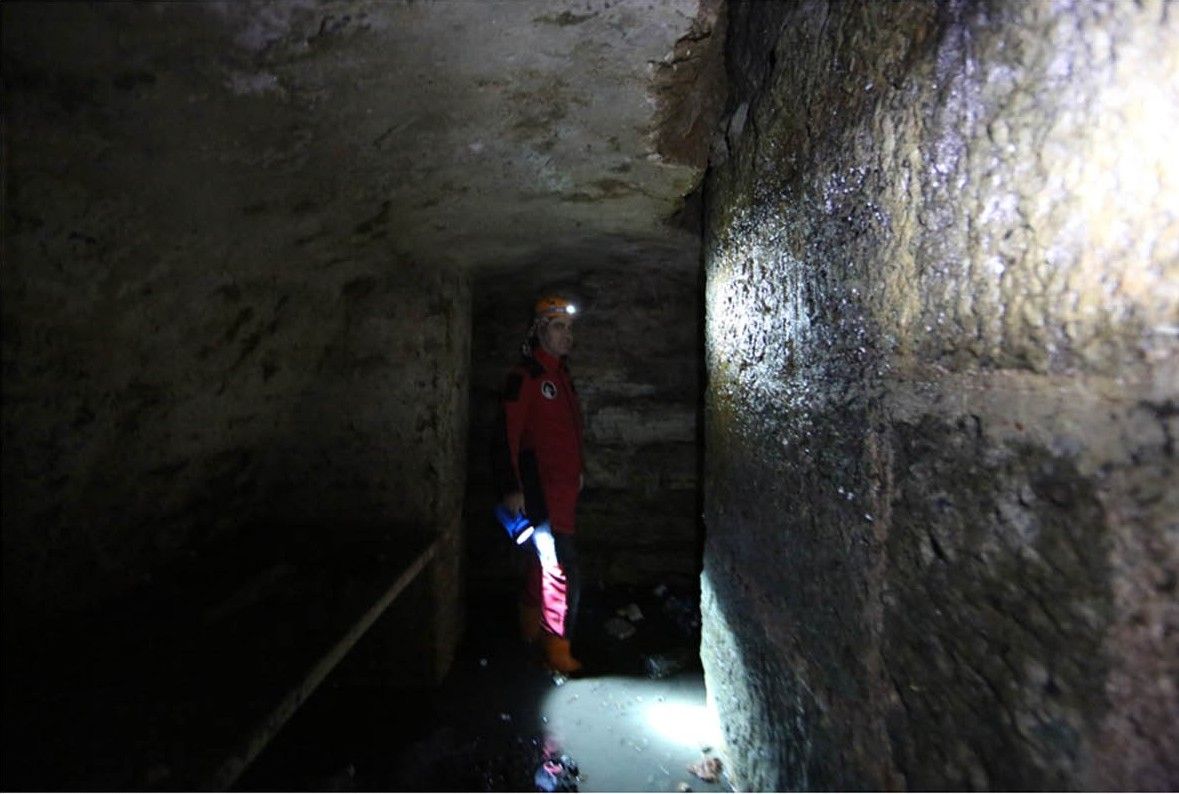
Beneath Hagia Sophia, 3,000 tons of mud cleared from Roman tunnels
A member of the monument’s scientific board says about 3,000 tons of mud and rubble have been removed from the tunnels under Hagia Sophia since February 2025, with work reaching layers older than Justinian’s church. It is a progress report on a clearing project that is still under way.
by VRSZ Editors · October 17, 2026 · 4 min read
A talk in Istanbul
The underground structures around Hagia Sophia in Istanbul are being cleared of mud and rubble that has filled them for centuries. On October 16, Prof. Hasan Fırat Diker, an architect and a member of the Hagia Sophia scientific board, gave an update at a public talk. Anadolu Agency reported his remarks in its Turkish-language service early on October 17.
The talk, “The Archaeology of Hagia Sophia,” opened the “Istanbul Conversations” series organized by İş Sanat and moderated by Cengiz Özdemir. It was held at BlackBox, a cultural space inside the Türkiye İş Bankası Painting and Sculpture Museum on İstiklal Avenue.
Diker said work in the tunnels is continuing. According to Anadolu, he said about 3,000 tons of mud and rubble have been removed since February 2025.
What has been cleared
Diker described the tunnels as highly complex and compared them to a metro network. In his account, the Romans built them about 1,600 years ago to carry rainwater off the street and out to the sea, and to distribute the city’s water supply.
Among the structures is what he called the “Roman Street,” a fifth-century route that runs from Sarayburnu, the point of the old city, toward Little Hagia Sophia. The German archaeologist Alfons Maria Schneider first uncovered and documented its upper part in the 1930s. The board is now working on its lower part. Diker said 170 meters of the route have been cleared so far, work he said had never been possible before.
He also said the first church on the site lies about 2.3 meters below the present building. Without modern trucks to haul away debris, he explained, the city was rebuilt again and again on top of its own ruins.
The hypogeum
The most layered part of the site, Diker said, is the area outside the northeast face of the building. There, in 1946, the museum director Muzaffer Ramazanoğlu found a hypogeum, an underground burial structure. His team has now cleared both its upper and lower parts.
“We went a meter and a half further down beneath the hypogeum. It was full of mud. This part is older than Hagia Sophia,” Diker said (translated from the Turkish).
A hypogeum is a burial structure built below ground. This one lies about four meters down, between Hagia Sophia and its Ottoman soup kitchen. In a 2023 article in the journal Open Archaeology, Diker described it as Roman tomb chambers of brick, roofed with plain plastered vaults and joined by a passage, with niches for the dead known as arcosolia. The niches are empty. Ramazanoğlu dated it to the fourth century, and Diker has called it the oldest building yet found around Hagia Sophia. It is not clear whether it belonged to the first church or to the earlier city.
The October report describes the hypogeum as four rooms side by side. Diker’s 2023 survey, and Anadolu’s earlier reports in 2022 and January 2025, describe three chambers. The new report does not say whether a fourth room has been found.
“We went a meter and a half further down beneath the hypogeum. It was full of mud. This part is older than Hagia Sophia.”
Hasan Fırat Diker · via Anadolu Agency, translated from the Turkish
Three churches on one site
The building that stands today is the third church on the site. The first, called the Great Church, was consecrated in 360 under the emperor Constantius II. Later tradition credits his father, Constantine, with founding it. It burned in 404 during unrest that followed the exile of the patriarch John Chrysostom. A second church, built under Theodosius II, was dedicated in 415. It burned in the Nika riot of January 532.
Justinian then had the present building raised by the architects Anthemius of Tralles and Isidore of Miletus. It was dedicated on December 27, 537. For more than nine centuries it was the cathedral of Constantinople, and from 1204 to 1261 it served as a Latin cathedral. After 1453 it was a mosque. It became a museum in 1935, and it has been a mosque again since 2020. Remains of the Theodosian church’s western entrance, found by Schneider in the 1930s, still lie in front of the building.
What comes next
The clearing is one part of a wider restoration of the building. In January 2025, Anadolu reported that the General Directorate of Foundations was beginning a cleaning of about a kilometer of tunnels, cellars and the tomb, expected to take a year, with part of the network to be opened to visitors afterward. Twenty-one months later the work continues. Diker said the board is working carefully so that large parts of the underground can be opened to visitors, and that it will prepare an exhibition project. No opening date has been announced.
Read it for yourself
Open VRSZ, tap Proverbs 9:1, and read what the early Christian writers said about the house that Wisdom built.
Proverbs ix. 1
1Wisdom hath builded her house, she hath hewn out her seven pillars:
Read the commentaries on Proverbs 9:1Know someone who would want to read this?
Sources quoted
- Anadolu Agency, “Ayasofya Bilim Kurulu Üyesi Prof. Dr. Hasan Fırat Diker, ‘Ayasofya’nın Arkeolojisi’ni anlattı,” October 17, 2026, as carried by Hürses and Kitahaber (quotations from Hasan Fırat Diker translated from the Turkish).
- Türkiye Today, “Archaeologists remove 3,000 tons of debris from tunnels beneath Hagia Sophia,” October 17, 2026.
- Anadolu Agency, “Ayasofya’nın yer altı yapıları temizlenerek ziyarete açılacak,” January 3, 2025, and “Ayasofya’nın en büyük yer altı yapıları görüntülendi,” August 29, 2022.
- Hasan Fırat Diker, “The Story of the Architectural Documentation of Hagia Sophia’s Hypogeum,” Open Archaeology 9 (2023), doi 10.1515/opar-2022-0303.
- Encyclopaedia Britannica, “Hagia Sophia”; Wikipedia, “Hagia Sophia” (dates of the first and second churches).
- Proverbs 9:1, King James Version.
- Header photo: inside the hypogeum beside Hagia Sophia, 2020. H. F. Diker, Open Archaeology 9 (2023), Figure 23 (cropped), CC BY 4.0.