Of Interest ·
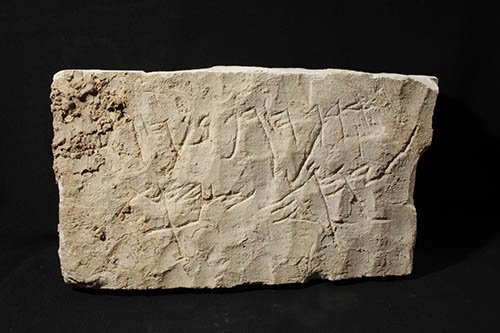
A curse in stone, and the oldest “Lord of Hosts” outside the Bible
A small limestone block from a burial cave near Hebron, written in Paleo-Hebrew, calls down Yahweh Sabaot on a man named Hagaf. It is probably the earliest evidence outside Scripture for the title that Isaiah and Jeremiah used again and again.
by VRSZ Editors · October 15, 2026 · 4 min read
One line of letters
The stone is not much to look at: a rough, pale slab of limestone with one line of letters cut across its face. The letters are Paleo-Hebrew, the old script of the kingdoms of Israel and Judah, and they read: “Cursed be Hagaf son of Hagab by Yahweh Sabaot.”
That is all of it. Someone wanted Hagaf punished, and the power they called on was the God of Israel under his title of war and majesty, Yahweh Sabaot, “the LORD of hosts.” The Bible Lands Museum Jerusalem, which holds the stone as BLMJ 4663, dates it to about 800–750 BC. The museum describes it as coming from a burial cave in Judah, in the Hebron area. Nothing else is known about Hagaf, or what he did to earn the curse.
A name from Judah
Hagab is a real Hebrew name, and it means “grasshopper.” It turns up in the Bible too. Among the families who came back from Babylon, Ezra lists “the children of Hagab” (Ezra 2:46). There is no reason to link the two, since they are centuries apart. Still, it is a small reminder that the names on these stones were the names of ordinary people in the land.
The spelling varies in English: the museum’s older catalog gives “Hagaf son of Hagab,” and recent press gives “Hagav.” Hebrew b and v are the same letter, so the difference comes from how the letter is transliterated, not from the stone.
Curses in the dark
Curses and blessings in the name of Yahweh were scratched into tombs in the Judean hills during the First Temple period. The best known come from caves at Khirbet el-Qom, west of Hebron, and one online anthology of Jewish texts catalogs a near-identical curse among them. The exact find-spot of the museum’s stone, though, is not given in the sources we checked, so it is safest to say simply: a burial cave, in the Hebron area, in the kingdom of Judah.
What these inscriptions show is the faith of ordinary Judeans. They knew God’s name, and they used it, sometimes to bless and sometimes to curse.
The LORD of hosts
The title on the stone is everywhere in the Hebrew Bible. “Yahweh Sabaot” appears more than two hundred times. It is especially frequent in the prophets, in Isaiah, Jeremiah and Zechariah. The “hosts” are armies, of Israel or of heaven. The title pictures God as the commander of every power in heaven and on earth.
It is old even in the Bible. At the start of 1 Samuel, Elkanah goes up yearly “to worship and to sacrifice unto the LORD of hosts in Shiloh” (1 Samuel 1:3). The Psalms answer their own question, “Who is this King of glory? The LORD of hosts, he is the King of glory” (Psalm 24:10). Above all there is Isaiah’s vision in the Temple, in the year King Uzziah died, as the seraphim cry, “Holy, holy, holy, is the LORD of hosts: the whole earth is full of his glory” (Isaiah 6:3).
Isaiah lived in eighth-century Jerusalem. If the museum’s date is right, the man who cut this curse lived in the same small kingdom in the same century, and used the same name for God.
“Holy, holy, holy, is the LORD of hosts: the whole earth is full of his glory.”
Isaiah 6:3 · King James Version
How early is “earliest”?
The museum and the Biblical Archaeology Society call the inscription “perhaps the earliest non-Biblical evidence” for the title, and recent coverage says it is “considered” the earliest. That is a fair claim, with the usual cautions. The date comes from the shape of the letters, not from a dated layer of earth, so it could be somewhat later. Either way, it is among the oldest uses of “Lord of Hosts” in Hebrew outside Scripture.
On display
The stone is now part of “Six After the War,” an exhibition at the Bible Lands Museum on ancient war and on hopes for peace. Its neighbors include an inscription of the Assyrian king Sennacherib boasting of his devastation of Judah, shown beside Isaiah’s prophecy that the Lord of Hosts would defend Jerusalem.
Read it for yourself
Open VRSZ, tap Isaiah 6:3, and read what Christian writers through the centuries have said about the thrice-holy LORD of hosts.
Isaiah vi. 3
3And one cried unto another, and said, Holy, holy, holy, is the LORD of hosts: the whole earth is full of his glory.
Read the commentaries on Isaiah 6:3Know someone who would want to read this?
Sources quoted
- David Moster, “10 Great Biblical Artifacts at the Bible Lands Museum Jerusalem,” Bible History Daily (Biblical Archaeology Society), first published January 28, 2015, entry “Yahweh Ṣebaot Inscription,” BLMJ 4663.
- Assaf Golan, “2,800-year-old curse reveals surprising detail about Kingdom of Judah,” Israel Hayom, October 8, 2026.
- Posen Library, “Curse in Burial Cave at Khirbet el-Kom (Makkedah) #6,” catalog entry.
- Isaiah 6:3; 1 Samuel 1:3; Psalm 24:10; Ezra 2:46, King James Version.
- Header photo: BLMJ 4663, Bible Lands Museum Jerusalem collection, as reproduced by Bible History Daily. © BLMJ.