Of Interest ·
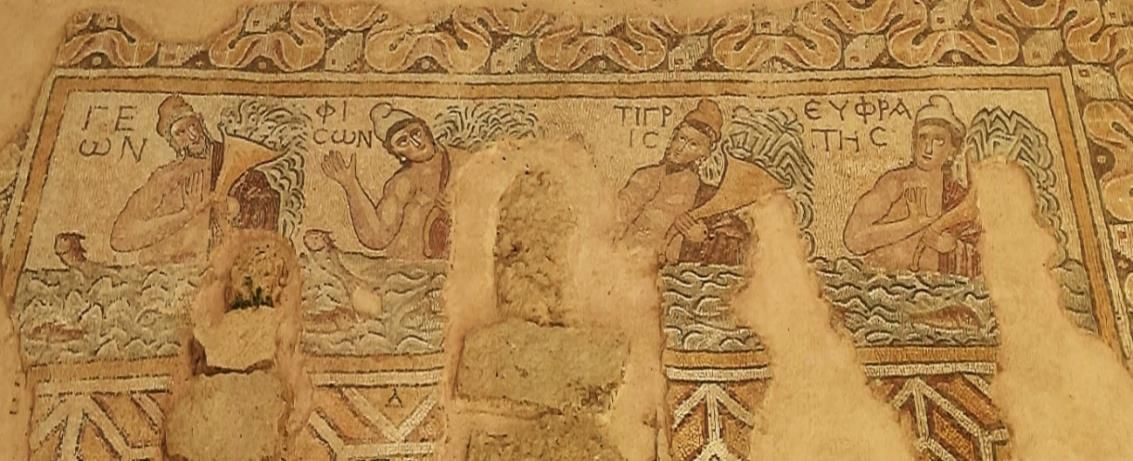
The four rivers of Paradise on a church floor in Anatolia
At Hadrianoupolis, in northern Türkiye, a 1,500-year-old church floor shows the rivers of Eden as four named human figures, a picture of how early Christians read the second chapter of Genesis.
by VRSZ Editors · October 14, 2026 · 4 min read
A river out of Eden
Genesis tells of a river that “went out of Eden to water the garden; and from thence it was parted, and became into four heads” (Genesis 2:10). It then names the four: Pison, Gihon, Hiddekel (the Tigris) and Euphrates.
At Hadrianoupolis, an ancient city near the modern town of Eskipazar in Karabük province, the floor of an early Byzantine basilica turns that passage into a picture. In one long panel, four half-length human figures rise from rippling water filled with fish. Each one is labeled in Greek: ΓΕΩΝ (Geon, or Gihon), ΦΙϹΩΝ (Phison, or Pishon), ΤΙΓΡΙϹ (Tigris) and ΕΥΦΡΑΤΗϹ (Euphrates). They wear Phrygian caps and hold horns of plenty, their free hands raised in greeting. Gihon and Euphrates are bearded; Tigris and Pishon are not.
The Church of the Four Rivers
Excavations at Hadrianoupolis began in 2003, and the church’s mosaics were published in the 2012 Journal of Mosaic Research. An architectural study of the building, first called “Church B,” renamed it the Church of the Four Rivers after this panel, and dated it to the fifth or sixth century on the basis of its architecture and decoration.
The theme was loved across the Christian world. The four rivers also appear on church floors at Tegea in Greece, Madaba and Umm er-Rasas in Jordan, Qasr Libya in Libya, and Ohrid in North Macedonia. Here, in a Greek-speaking city of Paphlagonia, the faithful walked over Paradise on their way to worship.
Rivers as virtues
How would they have understood it? One answer runs deep in the tradition. In the first century, Philo of Alexandria wrote of Genesis 2:10–14: “In these words Moses intends to sketch out the particular virtues. And they also are four in number, prudence, temperance, courage, and justice.” For Philo, the single river flowing out of Eden is goodness itself, and the four streams branch off from it.
Some three centuries later, St. Ambrose of Milan took up the same reading in his treatise On Paradise (chapter 3). The fountain that waters Paradise, he writes, is the Wisdom of God, the source of the virtues. Its four “beginnings” are prudence, temperance, fortitude and justice, and the first river, Phison, is prudence. Ambrose’s pairings differ a little from Philo’s: he links the Gihon with temperance and chastity, where Philo links it with courage.
Researchers at Karabük University, Nurgül Özer Uras and Mustafa Göregen, have suggested that the Hadrianoupolis figures may carry this meaning too, following Philo’s pairing: Pishon for prudence, Gihon for courage, Tigris for temperance and Euphrates for justice. They also connect the fish and flowing water with baptism and divine abundance.
“In these words Moses intends to sketch out the particular virtues.”
Philo of Alexandria · Allegorical Interpretation I.63, trans. Yonge
The rest of the floor
The church holds other images as well. A panel shows a bull drinking from a pool, under a Greek dedication translated as a gift of “the faithful Scholarius Himerius and the honest and respected Valentina.” There is a peacock from a refrigerium scene, a motif linked to eternal life, and a cross-shaped motif at the southeastern entrance, read as apotropaic, meant to ward off evil.
Why it matters
The mosaic belongs to the whole Church. Christians in Anatolia laid it out, and a reading first set down by a Jewish writer in Alexandria and taken up by a bishop of Milan may help explain it. The old reading still speaks: the waters of Paradise still flow wherever wisdom, courage, self-control and justice take root in a human life.
Read it for yourself
Open VRSZ, tap Genesis 2:10, and read what the early Christian writers said about the river that went out of Eden.
Genesis ii. 10
10And a river went out of Eden to water the garden; and from thence it was parted, and became into four heads.
Read the commentaries on Genesis 2:10Know someone who would want to read this?
Sources quoted
- Nurgül Özer Uras and Mustafa Göregen, “Arkeoloji, Din ve Sanatın Kesişimi: Hadrianoupolis / Dört Nehir Kilisesi Mozaiklerinde Yaratılış, 2:10-14’ün İkonografik ve Teolojik Yorumu,” Medeniyet Kültürel Araştırmalar Belleteni 6(10), 2026, 43–61, doi.org/10.60051/medbel.1887549.
- Leman Altuntaş, “1,500-Year-Old Church Mosaics in Türkiye May Reveal a Hidden Message About the Garden of Eden,” Arkeonews, October 14, 2026.
- Study of the Four River Church (2010–2014 seasons), SDU AVESİS record; S. Patacı, A. K. Öz and E. Laflı, Journal of Mosaic Research 5 (2012), 163–172.
- Philo of Alexandria, Allegorical Interpretation I.63, trans. C. D. Yonge (1854).
- Ambrose of Milan, De Paradiso 3.13–15 (Latin text, Wikisource), paraphrased.
- Genesis 2:10–14, King James Version.
- Header photo: the Four Rivers panel, Özer Uras & Göregen (2026), Medeniyet Belleten, fig. 13.