Of Interest ·
The Byzantine gold hidden above the Sea of Galilee
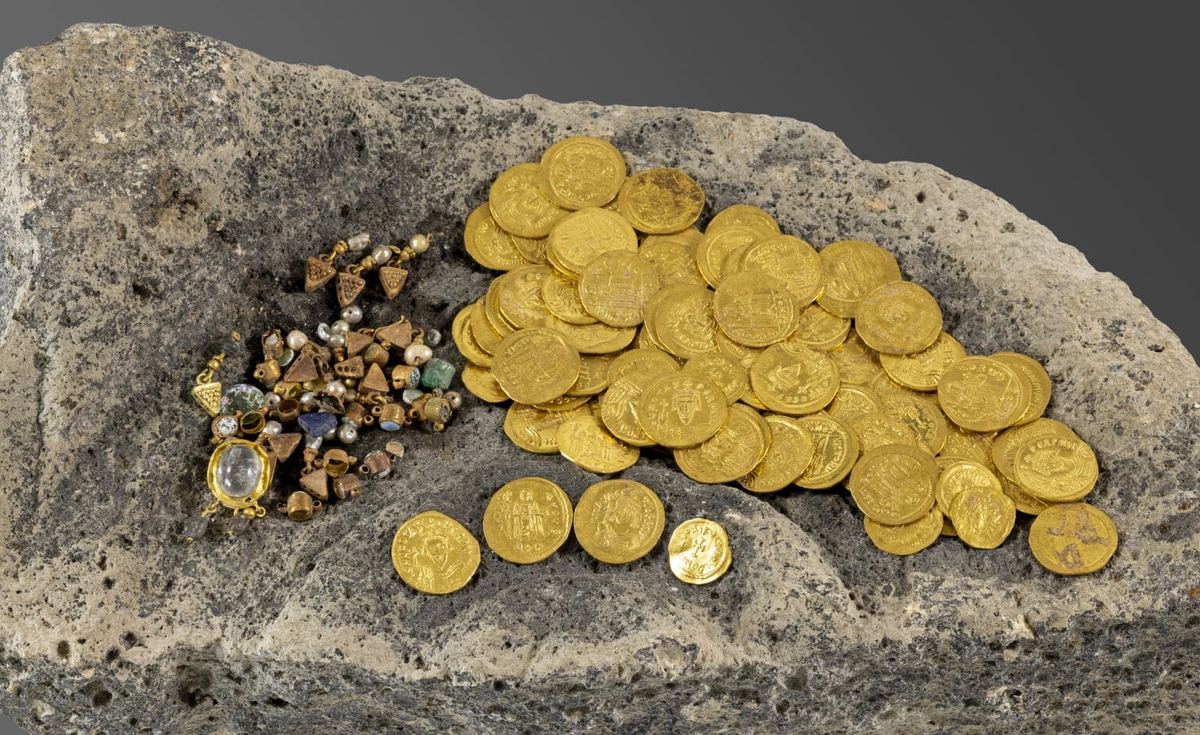
At Hippos-Sussita, a Christian city on a cliff over the lake, someone hid nearly 100 gold coins and fine jewelry between two walls as the Persian army approached in 614. They never came back for it.
by VRSZ Editors · October 12, 2026 · 4 min read
A chirp from the metal detector
The find started with a beep. A volunteer, Edie Lipsman, was sweeping a metal detector past a large stone at the excavations of Hippos-Sussita. At that moment no one knew what she had found. Bible History Daily reports that it turned out to be a large hoard of gold coins and jewelry from the last years of Byzantine rule in the Holy Land.
What the team found
Someone had tucked the treasure between two walls. When archaeologists dug it out about 1,400 years later, they counted nearly 100 gold coins and many pieces of fine jewelry.
The coins are Byzantine gold in three sizes: solidi, semisses and tremisses. The earliest come from the reign of Emperor Justin I (518–527) and the latest from the reign of Heraclius. The rarest is a tremissis minted in Cyprus in 610 by Heraclius and his son, while they were in revolt against Emperor Phocas. According to the team, this is only the second time such a coin has been found in Israel.
The jewelry runs to dozens of pieces, among them earrings set with pearls, semi-precious stones and glass. “The jewelry pieces are the greatest surprise for me,” said Arleta Kowalewska, who co-directs the excavation. “Fine craftsmanship combining semi-precious stones and pearls—I hope modern jewelers will recreate this beauty.”
Michael Eisenberg, the other co-director, called it “one of the major hoards from the Byzantine period discovered in Israel.” He added: “Its uniqueness lies in the combination of jewelry and gold coins from the reigns of different emperors.”
A Christian city in the path of war
In the Byzantine period (about 324–634), Hippos-Sussita was an important economic and Christian center. It was the seat of the region’s bishop and had at least seven churches. That made it a strategic target when the Sassanid Persian army invaded in 614. Someone in the city hid their wealth, hoping to come back for it once things were safe again.
The Persian conquest left clear marks at the site. One example is the burned remains of a church known as the Martyrion of Theodorus. Persian rule lasted about 15 years before the Byzantines took the region back. Then, in 636, Muslim armies conquered the Levant, and Byzantine rule there came to an end. The city lost importance after that, and it was abandoned after an earthquake destroyed it in 749.
“This is one of the major hoards from the Byzantine period discovered in Israel.”
Michael Eisenberg · excavation co-director, via Bible History Daily
A Gospel landscape
Hippos stood on the eastern shore of the lake, in the region the Gospels call Decapolis, the “Ten Cities.” Hippos is one of the cities that the Roman writer Pliny the Elder lists among them.
The Gospels bring Jesus to this shore more than once. St. Mark says that after leaving the region of Tyre and Sidon, “he came unto the sea of Galilee, through the midst of the coasts of Decapolis” (Mark 7:31). And the man freed from the legion of demons went home and “began to publish in Decapolis how great things Jesus had done for him” (Mark 5:20). Some six centuries later, the Christians of Hippos worshipped in sight of that same water.
Why it matters
A hidden hoard tells a very human story. Someone gathered what they valued most, hid it, and hoped to return. The gold stayed safe, but its owner never came back for it. Jesus spoke to exactly this kind of hope: “Lay not up for yourselves treasures upon earth, where moth and rust doth corrupt, and where thieves break through and steal: but lay up for yourselves treasures in heaven” (Matthew 6:19–20).
Read it for yourself
Open VRSZ, tap Matthew 6:20, and read what early Christian writers in both East and West said about the treasure that cannot be lost.
Matthew vi. 20
20But lay up for yourselves treasures in heaven, where neither moth nor rust doth corrupt, and where thieves do not break through nor steal:
Read the commentaries on Matthew 6:20Know someone who would want to read this?
Sources quoted
- Nathan Steinmeyer, “Golden Treasure Trove Discovered at Hippos,” Bible History Daily (Biblical Archaeology Society), biblicalarchaeology.org. The page notes the article was first published on October 10, 2025.
- Pliny the Elder, Natural History 5.18 (5.74), list of the Decapolis cities.
- Mark 5:20; Mark 7:31; Matthew 6:19–20, King James Version.
- Header photo: the Hippos-Sussita hoard, courtesy Michael Eisenberg, via Bible History Daily.