News ·
A piece of St. John’s relic goes back to Constantinople
More than eight centuries after it left the city in the aftermath of the Fourth Crusade, part of the relic of John the Baptist’s head has been given by the bishop of Amiens to Ecumenical Patriarch Bartholomew.
by VRSZ Editors · October 11, 2026 · 4 min read
A chapel in Picardy
The printed order of service was a single folded sheet. At the top it read “Vénération du chef de saint Jean-Baptiste,” the veneration of the head of St. John the Baptist. Below that came the name of the guest, Bartholomew I, archbishop of Constantinople-New Rome and Ecumenical Patriarch, and then the place and the date: the Chapelle Saint-Jean-du-Vœu in Amiens Cathedral, Friday, October 9, 2026.
At the bottom, printed in French, were two verses from the Gospel of John. In the King James Version they read: “There was a man sent from God, whose name was John. The same came for a witness, to bear witness of the Light, that all men through him might believe” (John 1:6–7).
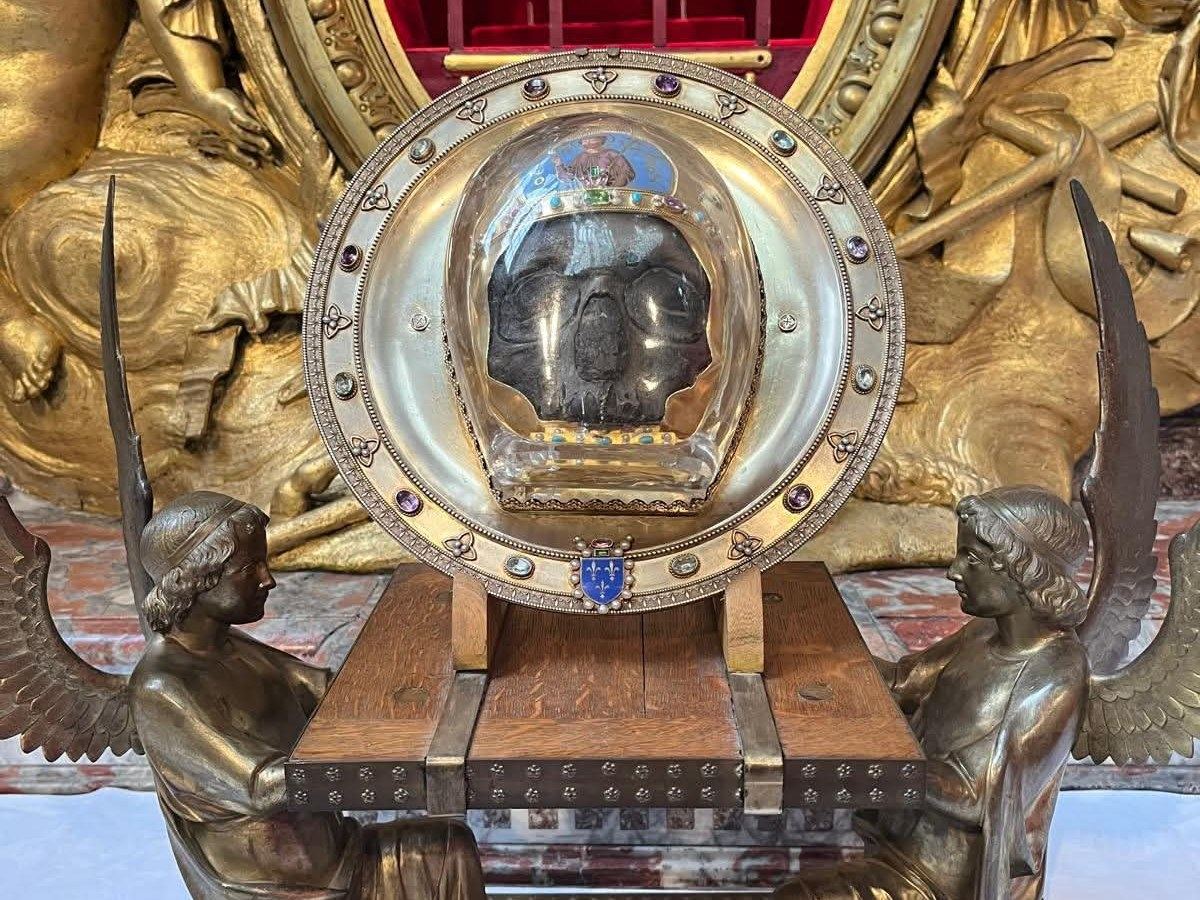
Photos released by the Ecumenical Patriarchate show the patriarch and his party reading prayers in the chapel. They also show the relic itself, a face behind rock crystal, set in a silver-gilt dish on a stand flanked by two kneeling angels.
What happened
According to Orthodox Times, which carried the Patriarchate’s announcement, Bartholomew visited the Roman Catholic Cathedral of Our Lady in Amiens, “where he was warmly welcomed by the Bishop of Amiens, Gérard Le Stang.”
With him were Metropolitan Emmanuel of Chalcedon, Metropolitan Dimitrios of France, Bishop Ambrosios of Sinope, and Grand Ecclesiarch Aetios, director of the Patriarchal Private Office. Together they venerated the head of St. John, which is kept in its own chapel in the cathedral.
Then Bishop Le Stang gave the patriarch a fragment of the relic. It will be placed for veneration by the faithful in the Patriarchal Church of St. George in Constantinople. The delegation was due to return to Constantinople that same evening.
How the relic came to Amiens
The cathedral’s treasury, documented online by France’s Ministry of Culture, tells the story in some detail.
Crusaders took Constantinople on April 12, 1204. Among the clergy who had come with the soldiers from Picardy was Walon de Sarton, a canon of the collegiate church of Saint-Martin in Picquigny. On September 8, 1206, he went to vespers at the church of St. George and found several reliquaries, one of which held the face of St. John. He broke the large silver dish the relic was set in so that he could take it, sailed for Venice on September 30, and reached Picardy in the following weeks. On December 17, 1206, Bishop Richard de Gerberoy received the relic at Amiens.
The treasury’s account is candid about this. It notes that some at the time called such acts a “pieux larcin,” a pious theft.
The sources differ slightly on where in Constantinople the relic was kept. The Patriarchate’s announcement says it came from the Monastery of Stoudios. The Amiens treasury says Walon found it in the church of the monastery of St. George of Mangana. It also records the view of the seventeenth-century scholar Du Cange that the relic had been divided around 1025, with part staying at the Stoudios monastery and part going to a church of St. George.
“There was a man sent from God, whose name was John.”
John 1:6 · printed on the Amiens order of service
Eight centuries of keeping
Walon kept one thing from the Byzantine reliquary: a mask of enameled gold, inscribed in Greek “Saint John the Forerunner,” which served as its certificate of authenticity.
Amiens treated the relic as the heart of its treasury. Twice a year, on June 24 and August 29, the feasts of John’s birth and of his beheading, it was carried in procession and shown to the faithful.
During a plague in 1668, Bishop François Faure vowed to build a new chapel of St. John. His successor Pierre Sabatier fulfilled the vow some forty years later by converting an existing chapel, which became the Chapelle Saint-Jean-du-Vœu, the chapel of the vow. That is where the patriarch prayed.
The medieval reliquary was melted down during the French Revolution. The relic and its rock crystal were saved by the mayor of Amiens, Louis Alexandre Lescouvé. The present reliquary was made in 1876 by the Paris goldsmith Placide Poussielgue-Rusand.
A gesture with a precedent
This is not the first time a Western church has sent relics back to Constantinople. On November 27, 2004, Pope John Paul II and Patriarch Bartholomew presided together in St. Peter’s Basilica over the return of relics of St. Gregory Nazianzen and St. John Chrysostom.
The Amiens gift is smaller in scale. Most of the relic stays where it has been for more than eight centuries; only a fragment travels. The figure of 822 years in the Patriarchate’s headline counts from the fall of the city in 1204. Even so, it is the same kind of act: a church giving part of something it has long treasured to the church of the city it came from.
Why this matters for Bible readers
John the Baptist belongs to everyone who reads the Gospels. Christians in Amiens and in Constantinople have honored him for centuries, and they have honored him for the same reason: he pointed away from himself.
That is how the Gospel of John introduces him, in the verses printed on the Amiens order of service. He was “sent from God.” He came “for a witness.” The next verse in John adds, of John the Baptist and the Light: “He was not that Light, but was sent to bear witness of that Light” (John 1:8).
A relic honors the man. But what John did with his life was to turn every eye toward someone else. A gift exchanged between two churches that have not always been at peace is, in a small way, the same kind of witness.
Read it for yourself
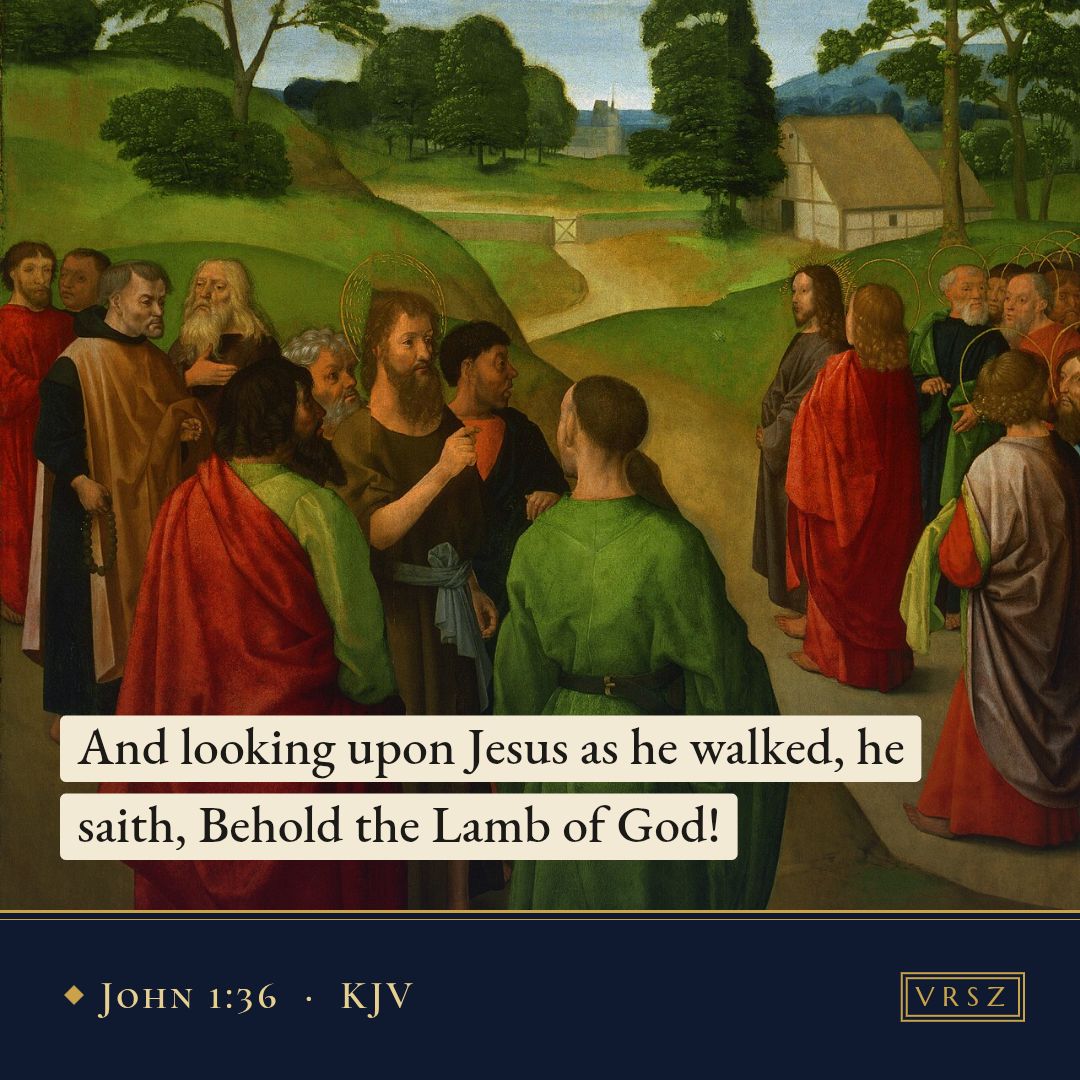
When John saw Jesus coming toward him at the Jordan, he said, “Behold the Lamb of God, which taketh away the sin of the world” (John 1:29). Open VRSZ, tap John 1:29, and read what early Christian writers said about the words of the Forerunner.
John i. 29
29The next day John seeth Jesus coming unto him, and saith, Behold the Lamb of God, which taketh away the sin of the world.
Read the commentaries on John 1:29Know someone who would want to read this?
Sources quoted
- Orthodox Times, “A fragment of the Head of St. John the Forerunner returns to Constantinople after 822 years,” Oct 9, 2026, orthodoxtimes.com (photos: Ecumenical Patriarchate).
- Ecumenical Patriarchate, announcement of Oct 9, 2026 (Greek), with photos of the visit and the order of service, ec-patr.org.
- Le trésor de la cathédrale d’Amiens (French Ministry of Culture), “La relique de la face de saint Jean Baptiste” and “Reliquaire de la face de saint Jean Baptiste,” tresor-cathedrale-amiens.culture.gouv.fr.
- Holy See, “Return of the Relics of Sts Gregory Nazianzen and John Chrysostom, 27 November 2004,” vatican.va.
- John 1:6–8; John 1:29, King James Version.