News ·
Two lost icons of the Evangelists come home to Cyprus
Stolen half a century ago, fourteenth-century icons of St. Matthew and St. Mark from the church of Asinou have been found in the United Kingdom and returned to the Church of Cyprus.
by VRSZ Editors · October 11, 2026 · 4 min read
Two faces, two books
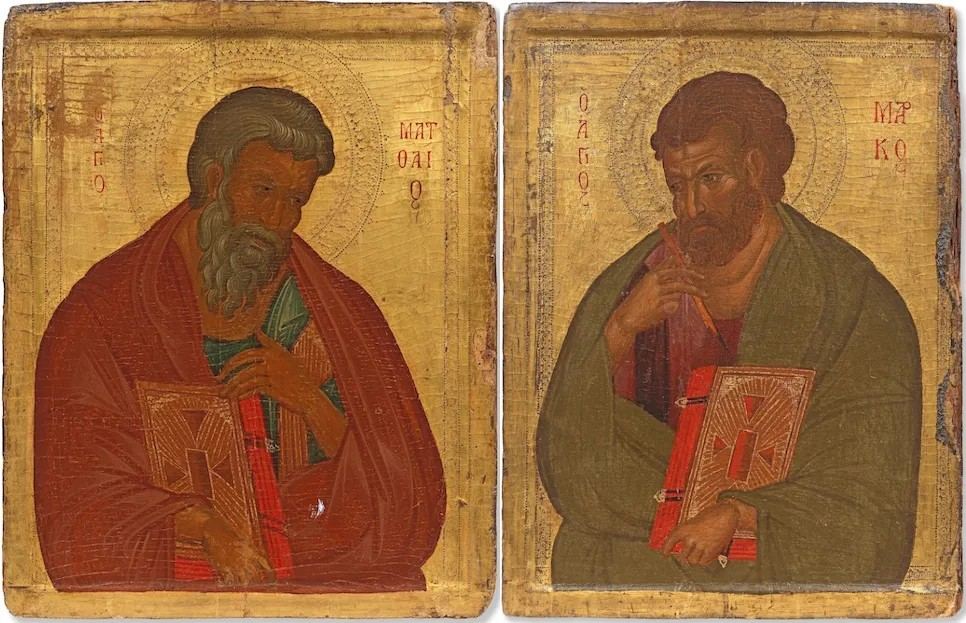
In the photograph released by the Metropolis of Morphou, the two icons stand side by side. On the left, St. Matthew, gray-haired and long-bearded, in a red cloak over a green tunic, holds a closed red Gospel book in the crook of his arm. On the right, St. Mark, dark-haired, in a green cloak over red, holds his book in one arm and a pen in the other hand, lifted toward his chin as if he were thinking about the next line. Both are painted against gold, with their names written in red beside their haloes. The gold has worn away in places and the wooden panels are scarred, but the faces are still calm and clear.
The icons are about two feet tall. According to the Metropolis, the Matthew panel measures 63 by 51 centimeters and the Mark panel 63.5 by 47.5. Both were painted in the fourteenth century in “egg tempera and gold leaf on wood.” For roughly fifty years, no one in Cyprus knew where they were.
What happened
On October 9, the Holy Metropolis of Morphou announced that the two icons had been returned to Cyprus, with the blessings of Archbishop Georgios of Cyprus and Metropolitan Neophytos of Morphou.
The press release gives a short history. The icons came from the Byzantine Church of Panagia Phorviotissa at Asinou. Before 1974 they had been moved to the premises of the Holy Metropolis of Kyrenia. After the Turkish invasion of that year, they were stolen from there.
The icons later turned up in the United Kingdom. Their movements were documented, the Church of Cyprus’s legal rights were recognized, and their return was secured. The Metropolis notes one detail in particular: the icons were handed over “at no financial cost, as the holder did not seek compensation.”
The release credits Dr. Christodoulos Hadjichristodoulou, a Byzantinist who advises the Metropolis on its monuments; Maria Paphiti, an art historian and former head of the icons department at Christie’s; and Bishop Porphyrios of Neapolis, who chairs the Church of Cyprus’s synodal committee on church monuments and Christian art. The lawyer George Hadjipieris handled the legal work. The Metropolis also thanked Cyprus’s Department of Antiquities, the Cyprus Police, Interpol, and the theologian and iconographer George Petrou.
“The return of two artefacts of faith, history and collective memory to the place where they were created.”
Holy Metropolis of Morphou · October 9, 2026
A row of saints, still incomplete
Matthew and Mark once belonged to a larger set. The Metropolis calls it the “Great Deesis” of Panagia Phorviotissa. In a Deesis, Christ is shown in the center with the Mother of God and John the Baptist turned toward him in prayer, and the apostles are often added on either side.
Two more icons from the same set, the Apostles Peter and Paul, were brought back to Cyprus from New York in 2007. The icon of Christ Pantocrator survives. According to the Metropolis, the icons of the Mother of God, St. John the Forerunner, and the Evangelists John the Theologian and Luke “remain missing.”
The church they came from is well known. Panagia Phorviotissa, often simply called Asinou, is a small church in the Troodos mountains. It is one of the ten “Painted Churches in the Troodos Region” that UNESCO added to its World Heritage List in 1985. UNESCO notes that its fourteenth-century wall paintings reflect, “to a certain degree, the revived art of Paleologan Constantinople,” the same era as the two icons. It also says that all ten churches “are living monuments and continue to be used as places of worship.”
Why it matters
An icon of an Evangelist was never meant to hang in a vault or a sale room. Its place was in a church, at the front of the nave, where people who had just heard the Gospel read aloud could look up and see the man who wrote it down.
The Metropolis said as much in its announcement: “It is not merely a matter of recovering two precious works of art. It is the return of two artefacts of faith, history and collective memory to the place where they were created, venerated and to which they belong.”
Matthew and Mark hold books because their work was to hand on what they had received. The good news they wrote down has been read in Cypriot churches for centuries. Now two of the faces that once watched over that reading are back where they belong.
Read it for yourself
Mark’s Gospel ends with the risen Christ’s charge to his disciples: “Go ye into all the world, and preach the gospel to every creature” (Mark 16:15). Open VRSZ, tap Mark 16:15, and read what early Christian writers said about the command that sent the Evangelists on their way.
Mark xvi. 15
15And he said unto them, Go ye into all the world, and preach the gospel to every creature.
Read the commentaries on Mark 16:15Know someone who would want to read this?
Sources quoted
- Holy Metropolis of Morphou, “Press release 9 October 2026: Two important Byzantine icons of the Holy Metropolis of Morphou repatriated to Cyprus” (English version), immorfou.org.cy. Header photo from the same release.
- UNESCO World Heritage Centre, “Painted Churches in the Troodos Region,” whc.unesco.org/en/list/351.
- Mark 16:15, King James Version.