News ·
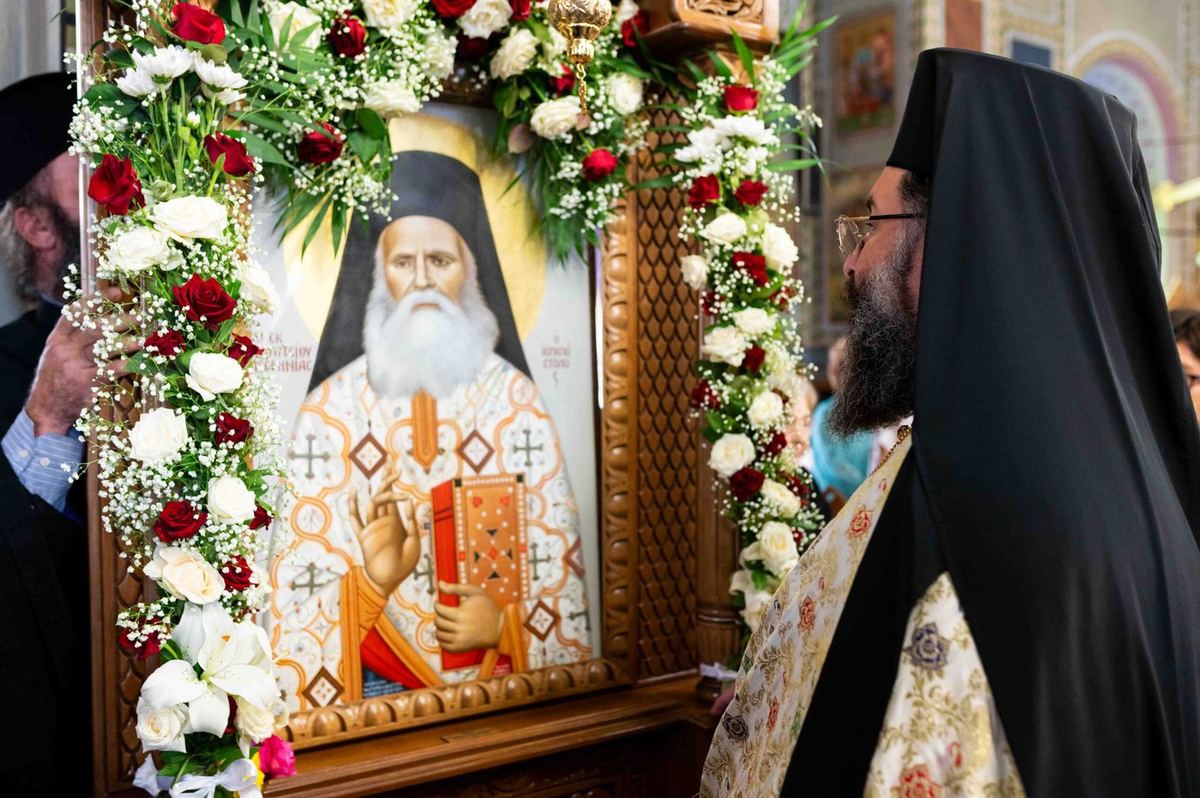
A missionary saint’s icon is enthroned in the village where he was born
A year after he was declared a saint, St. Chrysostomos Papasarantopoulos, who carried the Gospel to East Africa and the Congo in his old age, was honored with a new icon in his home village in Messinia, Greece.
by VRSZ Editors · October 11, 2026 · 4 min read
A Sunday in Vasilitsi
The icon stands in a carved wooden frame, so thickly garlanded with red and white roses and lilies that the flowers almost hide its edges. It shows an old priest-monk with a long white beard and a black monastic veil, his right hand raised in blessing, a red Gospel book in his left. A bearded clergyman in gold vestments stands close by, looking up at it.
The photographs come from the morning of Sunday, October 11, 2026, at the Church of St. Basil in Vasilitsi, a village in Messinia in the southern Peloponnese. According to a press release published by the Kalamata broadcaster BEST TV, many faithful from the wider area of Koroni filled the church for the enthronement of the new house icon of St. Chrysostomos Papasarantopoulos, the missionary of Africa, in the village where he was born.
What happened
The Divine Liturgy was led by Archimandrite Philippos Chamargias, the protosyncellus, or chief administrative priest, of the Metropolis of Messinia. Following church tradition, he anointed the icon with holy chrism and set it on what is now its permanent stand.
Afterward, Fr. Philippos conveyed the good wishes of Metropolitan Chrysostomos of Messinia. By happy coincidence, the Gospel read that morning was the parable of the Sower. The release says he tied the reading to the saint’s life: as a good sower, St. Chrysostomos sowed the word of God in Africa, and he did not sow a seed of his own, but the seed that God entrusted to him, in the field that God’s providence showed him. (The release is in Greek, and this summary is a VRSZ translation.)
He thanked the village priest, Fr. Fotios Moutzouris, and the parish council, especially the churchwarden Panagiotis Lymperis, for their work to keep Vasilitsi a living community. He also thanked the saint’s relatives, the Papasarantopoulos family, and the other donors who gave the new icon and its stand. The mayor of Pylos-Nestor, Panagiotis Karvelas, and the member of parliament for Messinia, Miltos Chrysomallis, were among those present.
Who he was
Christos Papasarantopoulos was born in Vasilitsi in 1903. He became a monk as a young man, taking the name Chrysostomos, and was ordained a priest in 1926. For decades he served in Greece, in monasteries, as a parish priest and as a confessor. He finished school as an adult, and he received a degree in theology from the University of Athens in 1958, at the age of 55.
Two years later, at 57, he left for Africa. He received the blessing of Patriarch Christophoros II of Alexandria, and in 1960 he arrived in Kampala, Uganda. Orthodox Times, reporting on his canonization, summed up what followed: “For ten years prior, he had preached the word of God in Uganda, Kenya, and Tanzania, building churches and saving souls.” He then moved to the Congo and founded the Orthodox mission there. Orthodox Times names the cities of Kolwezi, Kasenga, Kananga and Kinshasa. “He had no money,” it added; “he was sustained only by his faith in God and his love for humanity.”
A month before he died, he wrote in a letter, as quoted in English translation: “I love the Africans and am fully convinced that the Lord has brought me here.” He died in Kananga on December 29, 1972.
“I love the Africans and am fully convinced that the Lord has brought me here.”
St. Chrysostomos Papasarantopoulos · from a letter, 1972
How he became a saint
On October 8, 2025, the Holy Synod of the Patriarchate of Alexandria and All Africa, meeting in Alexandria under Patriarch Theodoros II, added him to the calendar of saints, together with Sylvester, a sixteenth-century patriarch of Alexandria. The decision came from the Church of Alexandria, whose territory covers the whole African continent, including the lands where he had worked.
Why it matters
Most missionaries start young. Chrysostomos began when most people are thinking about retirement, in poor health, with little money and few helpers. His story is a good reminder that the Gospel does not depend on the strength of the sower. As Fr. Philippos put it, the seed was not his own.
Read it for yourself
The parable read in Vasilitsi ends with the seed that fell on good ground: “they, which in an honest and good heart, having heard the word, keep it, and bring forth fruit with patience” (Luke 8:15). Open VRSZ, tap Luke 8:15, and read what early Christian writers said about the fruit that comes with patience.
Luke viii. 15
15But that on the good ground are they, which in an honest and good heart, having heard the word, keep it, and bring forth fruit with patience.
Read the commentaries on Luke 8:15Know someone who would want to read this?
Sources quoted
- BEST TV (Kalamata), press release on the enthronement of the icon of St. Chrysostomos at Vasilitsi, Oct 11, 2026 (Greek), best-tv.gr. Summary translated by VRSZ. Header photo from the same release.
- Orthodox Times, “Patriarchate of Alexandria: Canonization of Patriarch Sylvester and Father Chrysostomos Papasarantopoulos,” Oct 8, 2025, orthodoxtimes.com.
- Wikipedia, “Chrysostomos Papasarantopoulos” (biographical dates, and the letter quoted in English translation), en.wikipedia.org.
- Luke 8:15, King James Version.