News ·
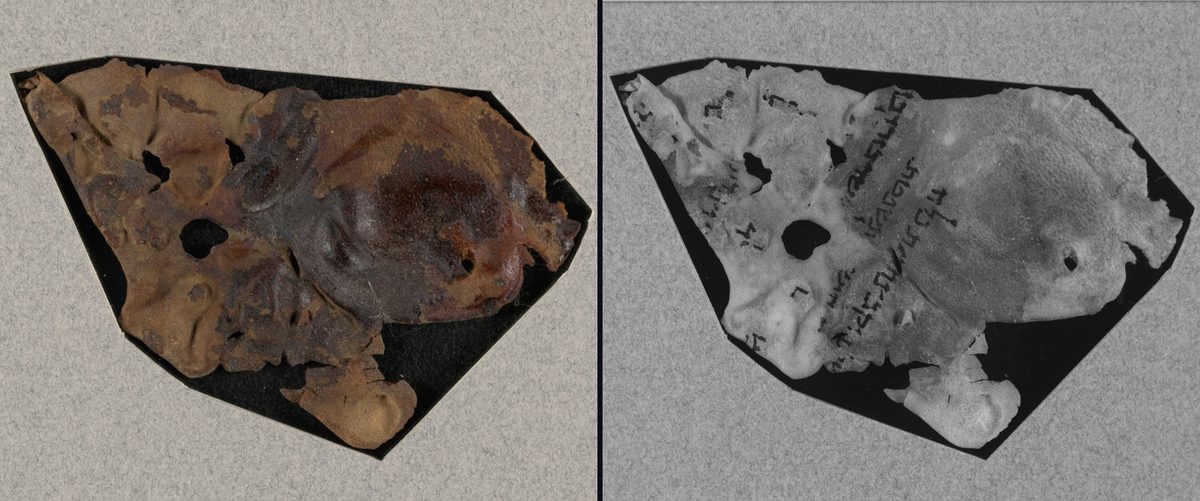
A Joel fragment, a new light, and an old question
New imaging of a “Dead Sea Scroll” fragment in Oslo’s Schøyen Collection has sharpened doubts about whether it is ancient at all. Here is what was found, what wasn’t, and why careful doubt is good news for Bible readers.
by VRSZ Editors · October 10, 2026 · 4 min read
Letters out of the dark
The fragment is a scrap of dark brown leather about ten centimeters by seven, carrying eight lines of Hebrew. To the eye it is nearly blank. The collection’s own catalogue puts it plainly: “The leather is so darkened that the text can only be read via infrared photography.”
This September, a team from the Center for the Study of New Testament Manuscripts (CSNTM) put that scrap, and thirty others like it, under multispectral light. The camera captures a manuscript under several wavelengths, one after another, and features the naked eye cannot see begin to show: faded ink, and the texture of the material underneath it.
What they saw on this fragment has reopened one of the quieter debates in biblical scholarship.
What CSNTM reported
CSNTM, a manuscript-imaging group based in Plano, Texas, was invited to digitally preserve dozens of items from the collection gathered by Martin Schøyen, working with the Oslo Cathedral School Rare Book & Manuscript Library. Thirty-one of those items are fragments said to be Dead Sea Scrolls.
The fragment catalogued as MS 4612-1 contains Joel 4:1–5. It was said to come from the caves at Qumran, and CSNTM gives its claimed date as 30 BCE to 68 CE. Imaging revealed text that was mostly invisible to the naked eye. But, according to CSNTM’s September 24 report, some of the ink “seems to be inconsistent with the wear of the leather medium” and “appeared to have been written over the worn out material.” In other words, the writing may have been added after the leather was already old and damaged, not before.
CSNTM was careful to add that “further analysis is necessary to draw firmer conclusions.”
Why one scholar called it significant
Årstein Justnes of the University of Agder in Norway has studied doubtful scroll fragments for years. He commented that the findings “could have major implications for Dead Sea Scrolls research,” because the fragment might be “the first known example of a Dead Sea Scroll forgery that predates 2002.”
That date matters. Starting in 2002, a wave of fragments described as Dead Sea Scrolls appeared on the antiquities market and was bought by collectors around the world. Scholars now regard that second wave as mostly inauthentic. The Joel fragment is older than that wave: it was published by Torleif Elgvin in 2016, and Justnes had already argued at a 2017 scholarly meeting that it was “in all probability” a modern forgery, as he and Josephine Munch Rasmussen later recounted in the journal Dead Sea Discoveries. The new images give that argument fresh evidence to weigh, though not a final verdict.
“…the first known example of a Dead Sea Scroll forgery that predates 2002.”
Årstein Justnes · quoted by CSNTM, Sept 24, 2026
The other side of the ledger
The report was not a blanket condemnation. CSNTM said that while most of the Schøyen scroll fragments appear to be modern forgeries, the imaging captured details that support the view that some are authentic. Elgvin, now professor emeritus at NLA University College in Oslo, joined the team, and together they found that several fragments show the physical characteristics of genuine fragments produced in the first century.
Denis Salgado of CSNTM summed up the project with restraint. The imaging is not conclusive about authenticity, he said, but the data “affirms some theories and challenges other assumptions.”
A pattern seen before
Readers may remember a similar story from Washington, D.C. On October 22, 2018, the Museum of the Bible announced that German testing of five of its sixteen scroll fragments found “characteristics inconsistent with ancient origin,” and took them off display. A fuller study, in a report dated November 2019, concluded that none of the museum’s textual fragments were authentic. Its team set out the theory that “modern writing was applied to small scraps taken from archeological deposits of leather.”
That proposal is strikingly close to what CSNTM now suspects on the Joel fragment: new ink on old, worn leather.
Why this matters for Bible readers
It would be easy to read a forgery story as bad news. It is closer to the opposite.
First, nothing about the text of Joel hangs on this scrap. Joel’s words are preserved in many ancient manuscripts, including other Minor Prophets scrolls from the Judean Desert that the collection’s own catalogue lists alongside it.
Second, the process is working as it should. Scholars raised a question, the owner’s library opened its doors, a team brought better tools, and the findings were published with their limits stated. That is how the record of Scripture’s history stays honest, and it protects the genuine witnesses by sorting them from the doubtful ones.
A note on numbering
If you look up “Joel 4” in an English Bible, you won’t find it. Hebrew Bibles divide Joel into four chapters, and most English Bibles into three. The fragment’s Joel 4:1–5 is what English readers know as Joel 3:1–5.
It is a passage about scattering and gathering. It opens, “For, behold, in those days, and in that time, when I shall bring again the captivity of Judah and Jerusalem,” and goes on to speak of a people “whom they have scattered among the nations” (Joel 3:1–2).
Read it for yourself
Whatever the final word on one small piece of leather, the passage it carries is easy to read. Open VRSZ, tap Joel 3:1, and read the verses this fragment was meant to show, along with what early Christian writers made of them.
Joel iii. 1
1For, behold, in those days, and in that time, when I shall bring again the captivity of Judah and Jerusalem,
Read the commentaries on Joel 3:1Know someone who would want to read this?
Sources quoted
- CSNTM, “What CSNTM Identified in the Schøyen Dead Sea Scroll Collection,” Sept 24, 2026, csntm.org.
- The Schøyen Collection, catalogue entry for MS 4612/1, schoyencollection.com.
- Årstein Justnes and Josephine Munch Rasmussen, “More Dubious Dead Sea Scrolls: Four Pre-2002 Fragments in the Schøyen Collection,” Dead Sea Discoveries 28 (2021).
- Museum of the Bible, press release, Oct 22, 2018; and Museum of the Bible Dead Sea Scroll Collection: Scientific Research and Analysis, Nov 2019.
- Joel 3:1–2, King James Version.