News ·
A lost island monastery comes back into view on Lismore
Volunteers on a small Scottish island and their archaeologist partners have found the workshops, burials and buildings of the monastery St. Moluag is said to have founded in the sixth century.
by VRSZ Editors · October 11, 2026 · 4 min read
A field beside the church
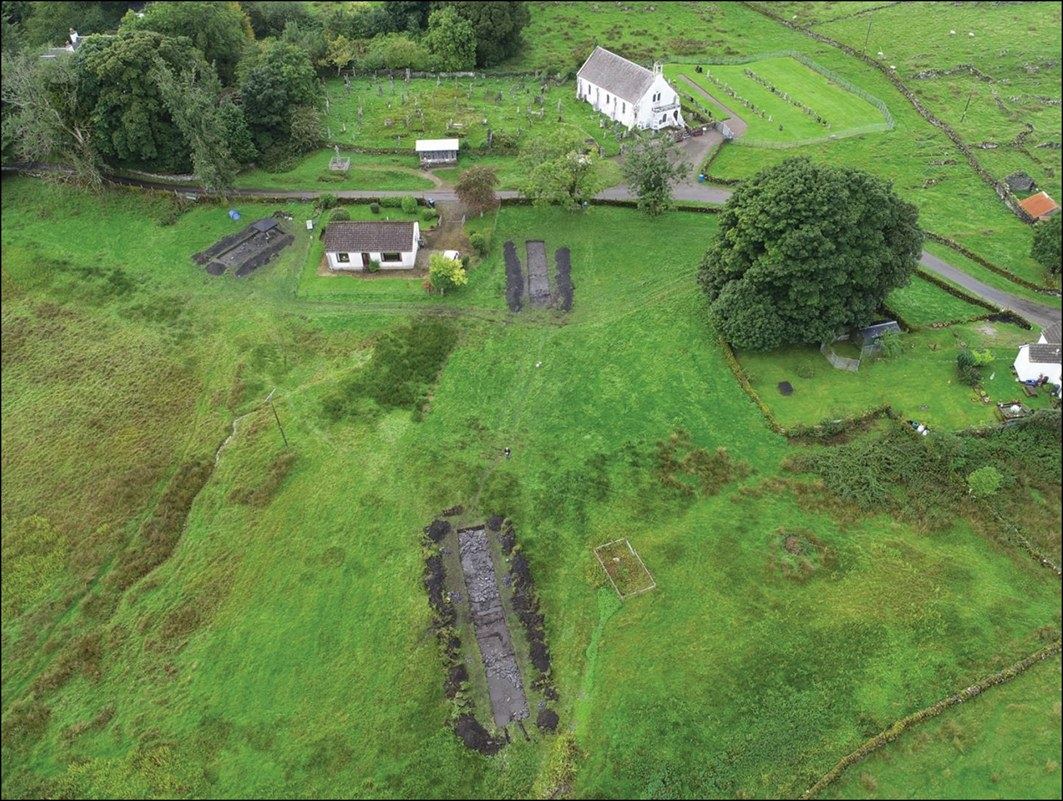
From the air, the site does not look like much. A white parish church stands in its walled graveyard. Beyond the road, long dark trenches are cut into a green field, with a cottage and a few trees nearby. The photograph was taken in 2019, during excavations on Lismore, a narrow island near Oban on Scotland’s west coast.
The Guardian describes Lismore today as an island of 190 people, with no row of shops and not even a pub. In one of those trenches, volunteers and archaeologists found the remains of a workshop where people had been working gold, silver and copper more than a thousand years ago.
“To be digging out the best small crucibles ever found in Scotland – it’s extraordinary,” Bob Hay, who organized the funding and the volunteers, told the Guardian.
What the team found
The results were published on October 1 in the journal Antiquity, in an open-access paper by Clare Ellis of Argyll Archaeology, Gordon Noble of the University of Aberdeen, Hay and five colleagues. The paper’s abstract sums up what changed: “Until recent decades, the monastery of Lios Mòr (Lismore) in Argyll, Scotland, established by Saint Mo Luóc in the sixth century, was attested only via historical references and local traditions. Community-led investigations have now revealed an early medieval cemetery, sophisticated craftworking of international importance and early structures around the island’s parish church.”
The work began in 2016, when the Lismore Historical Society launched an investigation of the site of the island’s thirteenth-century cathedral. “The research aimed to determine whether the site of the later medieval cathedral at Lismore was also the location of Mo Luóc’s early monastery, and to assess the scale, nature, and status of the settlement,” Ellis said in a statement from Antiquity.
The answer, the team says, is yes. In one trench the excavators found an oval building and a metalworking area. According to the paper, they recovered “more than 1000 fragments of non-ferrous metalworking debris, including well-preserved crucibles, crucible lids and fragments of moulds.” The moulds show that at least two types of penannular brooch were being cast on the site. Waterlogged ground preserved wood, bone and antler, including yew hoops from wooden vessels and bone “motif pieces” carved with fine interlace designs.
Smithsonian magazine reports that at least six burials have been radiocarbon dated to between 650 and 1040 A.D. So far, the strongest evidence for activity on the site dates from the seventh to the tenth centuries. Direct evidence from Moluag’s own sixth century has not yet been found.
“We can now see that it was a thriving centre of worship, craftsmanship and learning.”
Gordon Noble · University of Aberdeen
The saint behind the name
The saint is known by several forms of his name: Mo Luóc in the Irish spelling, Moluag in Scotland, and Lugaid in the old annals. According to the paper, the name means “my little Lu(g).”
Moluag came from north-east Ulster. The Annals of Ulster record his death in a brief entry, “Obitus Lugide Lis Moer,” which corresponds to A.D. 593 or 594. He was a contemporary of Columba, who founded Iona around 563, and a twelfth-century source credits Moluag with founding “no fewer than one hundred monasteries.”
Columba’s life was written down by Adomnán. As Hay put it to the Guardian, “Unfortunately, Moluag never had a hagiographer, so his contribution to the evangelisation of Scotland has been very much underestimated.”
The digging may help to make up for that. “For centuries, Lismore’s early monastery was known mainly from written records and local tradition. We can now see that it was a thriving centre of worship, craftsmanship and learning, whose importance may have rivalled some of the best-known monasteries in early medieval Britain,” Noble said in the Antiquity statement.
Why it matters
For Bible readers, the story is a reminder of how the Gospel reached much of Europe. Much of the work was done by small communities of monks, not by armies or empires. They settled on islands and coasts, prayed the Psalms through the day, copied the Scriptures, and taught their neighbors. A workshop that made fine brooches for powerful patrons also shows that such communities were not cut off from the world around them.
It is also a story about ordinary people caring for the place where they live. Noble told the Guardian the project was “very much a bottom-up approach of the heritage society coming up with a plan, working with professionals – and lo and behold, what a great series of discoveries they’ve made at the site.” Hay, in the Antiquity statement, credited “local volunteers and the Lismore Historical Society” with a central role.
Read it for yourself
The monks of the western isles sang the Psalms day after day. One of them begins, “The LORD reigneth; let the earth rejoice; let the multitude of isles be glad thereof” (Psalm 97:1). Open VRSZ, tap Psalm 97:1, and read what early Christian writers said about the joy of the islands.
Psalm xcvii. 1
1The LORD reigneth; let the earth rejoice; let the multitude of isles be glad thereof.
Read the commentaries on Psalm 97:1Know someone who would want to read this?
Sources quoted
- Clare Ellis, Angela Boyle, Gemma Cruickshanks, Nicholas Evans, Robert Hay, Edouard Masson-MacLean, Joshua Wright and Gordon Noble, “A major monastic centre? Rethinking Lismore’s place in the ecclesiastical landscapes of early medieval Britain,” Antiquity 100 (413), published online Oct 1, 2026, doi:10.15184/aqy.2026.10379 (open access, CC BY 4.0). Header image: Figure 4 of the paper.
- Antiquity, news release on the Lismore paper, with statements by Clare Ellis, Gordon Noble and Bob Hay, antiquity.ac.uk.
- Esther Addley, The Guardian, report on the Lismore finds, Sept 30, 2026, theguardian.com.
- Sonja Anderson, Smithsonian magazine, report on the Lismore finds, Oct 9, 2026, smithsonianmag.com.
- Psalm 97:1, King James Version.