News ·
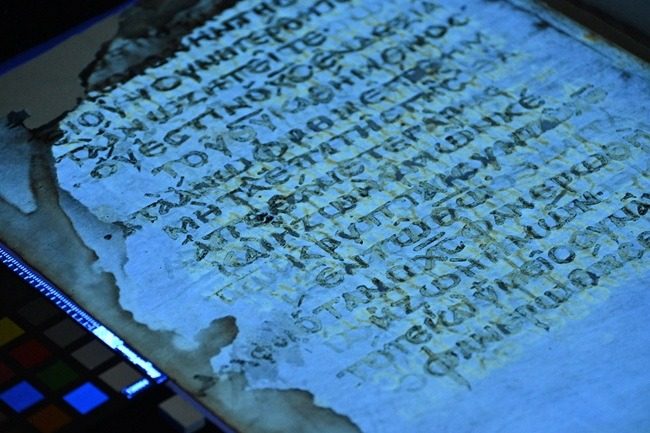
The ghost pages of Codex H
Scholars led by the University of Glasgow have read 42 lost pages of a sixth-century copy of Paul’s letters by recovering the faint imprints they left on the pages beside them.
by VRSZ Editors · October 10, 2026 · 4 min read
A mirror image in the parchment
Close a book and leave it closed for long enough, and the chemicals in its ink can press a faint, reversed copy of each page onto the page facing it.
That is what happened to Codex H. At some point the manuscript was re-inked, and the new ink marked the leaves next to it. Centuries later, those marks have let scholars read pages that no longer exist.
What the team found
Codex H is a sixth-century Greek manuscript of the letters of Paul. Around the thirteenth century it was taken apart at the Great Lavra Monastery on Mount Athos, in Greece. Its pages were reused as binding material and flyleaves for other books, and today the surviving fragments are scattered across libraries in Italy, Greece, Russia, Ukraine and France.
In an April 24, 2026 announcement, the University of Glasgow said an international team led by Professor Garrick Allen had recovered 42 of the manuscript’s lost pages. The story has been picked up again in recent weeks, including in an October 3 roundup drawing on a report by the Union of Orthodox Journalists.
Allen described the starting point. “We knew that at one point, the manuscript was re-inked,” he said. “The chemicals in the new ink caused ‘offset’ damage to facing pages, essentially creating a mirror image of the text on the opposite leaf – sometimes leaving traces several pages deep, barely visible to the naked eye but very clear with latest imaging techniques.”
Working with the Early Manuscripts Electronic Library, the team used multispectral imaging, which photographs a page under many wavelengths of light, “in order to recover ‘ghost’ text that no longer physically exists, effectively retrieving multiple pages of information from every single physical page.” Experts in Paris performed radiocarbon dating, which confirmed that the parchment comes from the sixth century. The work was funded by Templeton Religion Trust and the UK’s Arts and Humanities Research Council, with the cooperation of the Great Lavra Monastery, where the book was taken apart.
“Given that Codex H is such an important witness to our understanding of Christian scripture, to have discovered any new evidence – let alone this quantity - of what it originally looked like is nothing short of monumental,” Allen said.
“…nothing short of monumental.”
Garrick Allen · University of Glasgow, Apr 24, 2026
Not new letters, but new light
It is worth being clear about what this is not. The university notes that the recovered pages contain known portions of Paul’s letters. No lost epistle has turned up.
What has turned up is evidence of how Paul was read. The university lists three main findings. The pages hold the earliest known chapter lists for Paul’s letters, “which differ drastically from how we divide these letters today.” They show how sixth-century scribes corrected and annotated the text. And the manuscript’s own condition shows how sacred books were reused once they fell into disrepair.
The chapter lists are the most striking of these. Allen told Bible History Daily that Codex H divides Titus into six chapters rather than our three, each with a short title. The section covering what we call Titus 3:1–9 is headed: “On the obedience of rulers, following the leniency of Christ.” A heading like that tells you how to read the passage before you begin it.
Why this matters for Bible readers
The chapter and verse numbers in a modern Bible are useful, but they were added long after the letters were written, and they are not the only way the letters have been divided. Codex H is a reminder that early readers broke Paul into units of their own, gave those units titles, and wrote notes in the margins as they went. Reading Scripture closely, with help, has a very long history.
It also helps to remember when this book was made. As Bible History Daily points out, by the sixth century Paul’s letters had long been read as Scripture. Codex H does not come from a church deciding whether to keep Paul. It comes from a church already reading him, carefully, and making tools to read him better.
There is also something moving in the method itself. The lost pages were recovered because, page after page, the book pressed a little of itself onto the leaf beside it. The text survived partly by leaving its mark on its neighbors.
You can see the results for yourself. A free digital edition is available at codexh.arts.gla.ac.uk, and a print edition is forthcoming.
Read it for yourself
Paul cared about books. Near the end of 2 Timothy, he asks Timothy to bring his cloak, “and the books, but especially the parchments” (2 Timothy 4:13). We don’t know what those parchments held. But centuries later, a parchment copy of Paul’s own letters is being pieced back together from its ghosts.
Open VRSZ, tap 2 Timothy 4:13, and read what early Christian writers made of Paul’s request.
2 Timothy iv. 13
13The cloke that I left at Troas with Carpus, when thou comest, bring with thee, and the books, but especially the parchments.
Read the commentaries on 2 Timothy 4:13Know someone who would want to read this?
Sources quoted
- University of Glasgow, “42 lost pages of the new testament manuscript discovered,” Apr 24, 2026, gla.ac.uk.
- Lauren K. McCormick, “Paul’s Lost Words Recovered,” Bible History Daily, Biblical Archaeology Society, May 18, 2026, biblicalarchaeology.org.
- Union of Orthodox Journalists, “Scholars restore 42 pages of Apostle Paul’s lost letters,” Apr 27, 2026, spzh.eu; and Crazy Alchemist, “Lost Pages of Codex H, With Paul’s Letters, Recovered,” Oct 3, 2026.
- 2 Timothy 4:13, King James Version.