News ·
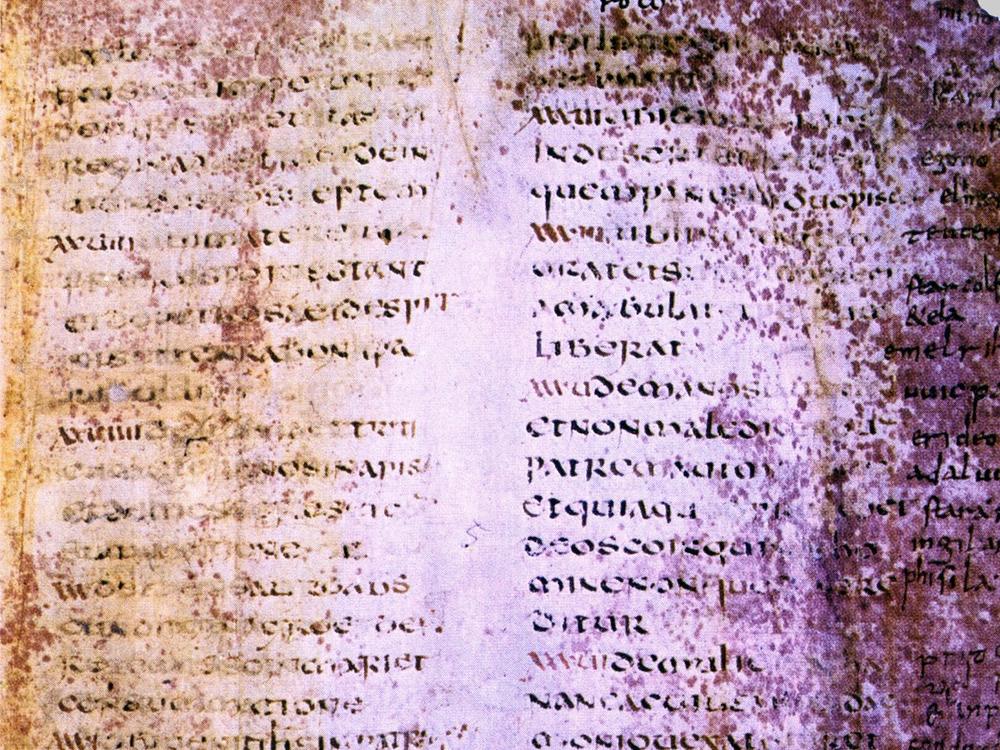
Three pieces of Mark, together again
For the first time in about seven centuries, the scattered parts of a sixth-century Gospel book once honored as Mark’s own handwriting are on view together in Aquileia.
by VRSZ Editors · October 10, 2026 · 4 min read
An emperor asks for a souvenir
In 1354, Charles IV of Luxembourg was traveling to Rome to receive the imperial crown, and he stopped in Aquileia, in the far northeast of Italy. The city’s patriarch was his half-brother, Nicholas of Luxembourg. Aquileia held a famous book: a Gospel of Mark believed to have been written by the evangelist’s own hand.
Charles asked for part of it. He came away with two of its seven quires, the stitched booklets that make up a bound book, and carried them to Prague, where they were placed in St. Vitus Cathedral alongside the relics of St. Wenceslaus.
That request began the scattering of the book. This autumn, its three surviving parts are together again in Aquileia.
The exhibition
“The Gospel of Mark: Seven Centuries. Three Fragments. One European Story” opened at Palazzo Meizlik in Aquileia on September 12, 2026, and runs until April 25, 2027. It is organized by Fondazione Aquileia with Italian, Czech and church partners, among them the Basilica of San Marco in Venice, the Metropolitan Chapter of St. Vitus in Prague, and the National Archaeological Museum of Cividale del Friuli.
The foundation calls the reunion “an operation of extraordinary scientific and symbolic value.” The Prague portion, considered part of the heritage of the Czech state and people, has left Czech territory for the first time.
One detail matters for anyone hoping to visit. Because the parchment is so fragile, the original manuscripts are displayed only during the exhibition’s first six weeks. After that, high-resolution digital reproductions take their place.
“…the Gospel of Mark acquired a life of its own and came to be regarded as an extraordinary relic.”
Cristiano Tiussi · to EWTN Noticias
A sixth-century book, not a first-century one
The book behind the legend is known as the Codex Forojuliensis, or Cividale Gospel Book. According to EWTN’s report, it was copied in the sixth century in uncial script and originally held all four Gospels in Jerome’s Latin translation. Scholars think it was most likely made in Ravenna.
Sometime in the twelfth or thirteenth century, the quires holding Mark were taken out of the larger book, rebound on their own, and covered in gilded silver. From then on the copy was treated as Mark’s autograph. “During the 12th and 13th centuries, the Gospel of Mark acquired a life of its own and came to be regarded as an extraordinary relic,” said Cristiano Tiussi, director of Fondazione Aquileia and curator of the exhibition.
The belief was tied to the local tradition that Mark himself first brought the Gospel to the region, and it gave the book a value that went beyond devotion. “Possessing part of the Gospel of St. Mark meant owning not only a religious relic but also a symbol of prestige, legitimacy, and power,” Tiussi said.
Prague, Venice, Cividale
After Charles took his share, the rest stayed in Aquileia until 1420, when Venice took control of the city. Venice claimed the remaining pages for the Basilica of St. Mark, where it had kept relics attributed to the evangelist since 828.
The lagoon was not kind to them. Humidity gradually damaged those pages until they became almost illegible, and the remnants are now kept in a reliquary display case in the Treasury of St. Mark. The Prague quires, by contrast, became the oldest written document preserved in Czech libraries. The third part is kept at Cividale del Friuli.
A book full of names
The exhibition also shows another side of the book. Before it was taken apart, it served as a Liber Vitae, a “Book of the Living.” More than 1,500 names were written into its pages by people who wanted to be remembered in the prayers of the community that kept it, among them Emperor Louis II, the Moravian prince Svatopluk, and envoys from newly Christian Bulgaria.
Curator Luca Villa explained why they did it. They wrote their names, he said, “because they believed that by doing so they would share in the liturgical celebrations every time the book was used in the church where it was kept.”
Why this matters for Bible readers
It is tempting to feel let down that the book is not really in Mark’s hand. But the true story may be the richer one.
No one has Mark’s original. What the church has always had is copies, made carefully, used in worship, and handed on. This sixth-century book is one of them. People loved it so much that they mistook it for the original, wrote their names into it so they could be held in prayer, and then competed for its pages. That is a picture of how Scripture actually reaches us: through many hands, across many centuries, and through a good deal of human history, some of it not very edifying.
Martina Dlabajová, the Czech curator, said the three pieces “never ceased to be part of a common narrative.” The same could be said of the text itself. Whether you read it in Prague, Venice or anywhere else, it is still one Gospel.
Read it for yourself
Mark’s Gospel starts without any preamble: “The beginning of the gospel of Jesus Christ, the Son of God” (Mark 1:1). Open VRSZ, tap Mark 1:1, and read that first line slowly, along with what early Christian writers said about it.
S. Mark i. 1
1The beginning of the gospel of Jesus Christ, the Son of God;
Read the commentaries on Mark 1:1Know someone who would want to read this?
Sources quoted
- Victoria Cardiel, “Fragments of medieval Gospel of St. Mark-turned-relic reunited after 7 centuries,” EWTN News, Sept 23, 2026 (first published by ACI Prensa), ewtnvatican.com.
- Fondazione Aquileia, press release, “In Aquileia for the First Time in Seven Centuries, the Three Fragments of the Gospel of Mark,” July 15, 2026, fondazioneaquileia.it.
- Mark 1:1, King James Version.